

Nylon (PA) 3D Printing Service
3D-printed nylon offers durability, heat resistance, and good long-term wear resistance

Our Nylon Capacities for 3D Printing
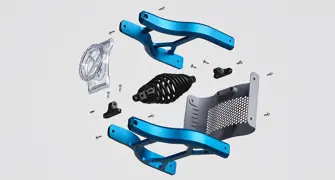
We offer multiple grades of nylons through our selective laser sintering (SLS) and Multi Jet Fusion (MJF) 3D printing processes. These powdered thermoplastic materials build durable parts with mechanical properties suitable for functional prototyping and end-use.
- PA 12 White
- PA 12 40% Glass-Filled White
- PA 11 Black
- PA 12 Black
- PA 12 Glass Beads Black
- PA 12 Carbon-Filled Black
Compare Nylon 3D Printing Material Properties
| Material | Process | Colour | Tensile Strength | Tensile Modulus | Elongation | More Details |
|---|---|---|---|---|---|---|
| PA 12 White | SLS | White | 50 ± 4 MPa | 2,000 MPa ± 200 MPa | 11% ± 4% | Data Sheet |
| PA 12 40% Glass-Filled White | SLS | White | 42 ± 4 MPa | 3600 ± 400 MPa | 5 ± 2% | Data Sheet |
| PA 11 Black | MJF | Black | 52 ± 4 MPa | 1,800 MPa ± 200 MPa | 30 ± 5% | Data Sheet |
| PA 12 Black | MJF | Black | 49 ± 4 MPa | 1900 ± 200 MPa | 12 ± 4% | Data Sheet |
| PA 12 Glass Beads Black | MJF | Black | 30 MPa | 2500 MPa | 10% | Data Sheet |
| PA 12 Carbon-Filled Black | SLS | Black | 85 MPa ± 5 MPa | 8,300 MPa ± 400 MPa | 3.2% ± 2% | Data Sheet |
Key Takeaways
|
Guidelines and Tips for Nylon 3D Printing
|
Feature
|
Recommendation
|
Notes
|
|---|---|---|
|
Wall thickness
|
SLS: minimum 0.762 mm*
MJF: minimum 0.508 mm |
Material-specific minima: 0.75 mm for PA12 Smooth White; 0.8 mm for PA12 Carbon-Filled Smooth Black; 1.0 mm for PA12 Glass-Filled Smooth White.
|
|
Channel gaps
|
Minimum 0.762 mm for both SLS and MJF
|
Ensure gaps allow powder removal and proper feature formation.
|
|
Knife edging / inset distal features
|
Keep distal features ≥ 0.762 mm (SLS) and ≥ 0.508 mm (MJF)
|
If smaller, features may not form correctly and can be shortened or rounded. Consider counter-bore/inset design carefully.
|
|
Part warpage
|
Maintain uniform wall thickness; use filled materials if geometry is prone to warping
|
Heat from sintering/fusing can cause warpage. Glass-filled materials help reduce warping for challenging geometries.
|

Applications for 3D-Printed Nylon
The mechanical properties of 3D-printed nylon makes it a common material for the following applications:
- Jigs and fixtures
- Housings
- Snap fits
- Living hinges
- Gears
- Bearings


