
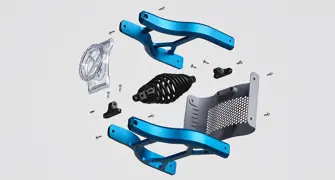

If you’ve worked with circuit board housings, composite aircraft parts, or even industrial coatings, chances are you’ve come across epoxy. This adaptable material is a cornerstone of modern manufacturing, valued for its strength, durability, and chemical resistance. But what exactly is epoxy—and why is it used so widely across industries?
What is Epoxy?
Epoxy is a type of plastic called a thermoset polymer. It’s made when epoxy resins react with special chemicals called hardeners or curatives.
Unlike thermoplastics that can melt and be reshaped when heated, epoxy doesn’t soften once it’s set. Instead, it goes through a permanent chemical reaction during curing. This reaction connects the molecules together into a tough, three-dimensional network. This process, called cross-linking, is what gives epoxy its strength and stability, even at high temperatures.
In epoxy, the epoxide groups (also called oxirane rings) in the resin react with hardeners such as amines, acids, or anhydrides. This reaction locks the material into a solid with excellent mechanical strength.
Properties of Epoxy
Understanding epoxy's key properties helps engineers select the right material for demanding applications. These characteristics make epoxy particularly valuable across aerospace, automotive, and electronics industries.
- Durability: Tough and long-lasting, able to resist wear, stress, and impact in demanding applications.
- Adhesion: Bonds strongly to metals, glass, ceramics, plastics, and composites, making it one of the most reliable adhesives.
- Electrical insulation: Prevents electricity from passing through, protecting circuit boards and high-voltage components.
- Temperature resistance: Holds its strength in extreme cold (down to about -55°C) and heat (up to 200°C or more, depending on the formula).
- Chemical resistance: Stands up to water, solvents, and many harsh chemicals, making it useful for coatings and protective layers.
- Dimensional stability: Shrinks very little during curing and maintains its size and shape over time, even under stress or temperature changes.

Applications of Epoxy in Manufacturing
Epoxy's versatility has made it indispensable across numerous manufacturing applications. From structural bonding to protective coatings, epoxy delivers reliable performance where other materials fall short.
- Adhesives: Creates permanent bonds between metals, composites, ceramics, glass, and more. Works at room temperature or with heat, and fills gaps while resisting environmental wear.
- Coatings: Provides long-lasting protection against corrosion and chemicals. Used in flooring, tank linings, pipe coatings, and anti-corrosion treatments for metal parts.
- Composite materials: Acts as the binding matrix in carbon fibre and glass fibre systems. Transfers loads between fibres and shields them from environmental damage, making it essential in aerospace, automotive, and marine industries.
- Electronics and electrical systems: Insulates and protects delicate parts. Common for encapsulating circuit boards, sealing sensors, and insulating high-voltage components.
- Tooling and moulds: Used to create prototypes, moulds, and precision tooling because it can be cast and machined with accuracy and dimensional stability.
- Construction materials: Strengthens and repairs concrete, bonds reinforcement materials, and provides durable flooring systems thanks to its strong adhesion and chemical resistance.
Types of Epoxy Systems
Think of an epoxy system like a recipe: you start with a resin, add the right curing method, and end up with very different results depending on the mix. Each “recipe” is designed to fit certain production needs, curing conditions, and performance requirements. The main types include:
- One-part epoxies: Pre-mixed and cured with heat. Great for high-volume production, but they require elevated processing temperatures.
- Two-part systems: Resin and hardener are mixed just before use. They cure at room temperature but need precise ratio control.
- Thermal curing: Uses heat to speed up the reaction, delivering the best strength and chemical resistance.
- UV curing: Hardens quickly under light exposure, ideal for thin coatings and electronics.
- Room temperature curing: Flexible and easy to use, but slower and generally not as strong as heat-cured systems.
- Moisture-curing formulations: React with moisture in the air, making them handy for sealants and adhesives in variable environments.
Epoxy Systems Quick Look
|
Epoxy system |
How it cures |
Key advantages |
Typical uses |
|
One-part |
Heat |
Convenient, pre-mixed |
High-volume production |
|
Two-part |
Resin + hardener mix |
Room temp curing, versatile |
Adhesives, repairs, coatings |
|
Thermal curing |
Heat |
Strongest properties |
Aerospace, industrial components |
|
UV curing |
UV light |
Very fast, thin sections |
Coatings, electronics |
|
Room temp curing |
Ambient conditions |
Flexible, easy to use |
Prototyping, general repairs |
|
Moisture curing |
Moisture in air |
Works in variable environments |
Sealants, adhesives |
Choosing the right system depends on the part’s geometry, production scale, and the mechanical performance you need.
Epoxy in Protolabs' Services
Protolabs leverages epoxy's unique properties across our manufacturing technologies to deliver high-quality parts for prototyping and production.
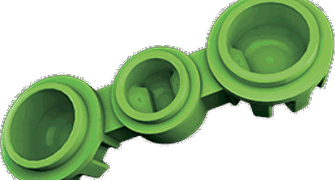
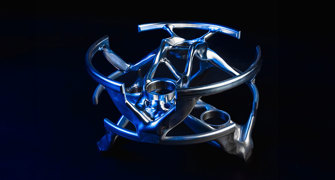
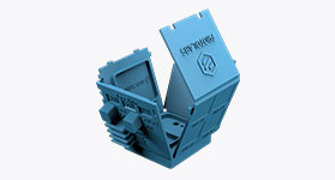
- 3D printing: Epoxy resins are used in both stereolithography (SLA) and Carbon Digital Light Synthesis (DLS). SLA produces smooth, high-resolution prototypes with fine feature detail, while DLS combines epoxy formulations with digital light technology to create strong, production-quality parts with complex geometries. Epoxy is also used during post-processing of SLA parts, where it helps secure threaded inserts for added functionality.
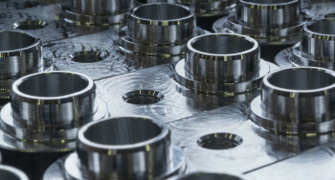
- CNC machining: Epoxy composites can be precisely machined for demanding applications, while epoxy also serves as protective coatings on machined metal parts for added corrosion and chemical resistance.
- Injection moulding: Epoxy is used as a thermoset plastic to produce durable parts with strong temperature resistance, dimensional stability, and chemical protection.
Advantages of Using Epoxy Through Protolabs
Working with Protolabs gives you more than just access to epoxy's material benefits. It also means faster production, tailored options, and expert support.
- Custom options: Pick the epoxy that fits your job, whether that’s flame-retardant for electronics or high-strength for structural parts. You can order what you need without being locked into big minimums.
- Reliable quality: Every part is made to spec. We keep a close eye on curing conditions so the results are accurate and consistent run after run.
- Fast turnaround: Our automated systems and streamlined processes cut lead times so you can go from design to finished part quickly.
- Expert insights: Our platform provides instant design feedback through built-in DFM tools, and our engineering team is available for deeper guidance if you need help optimising geometry, selecting the right epoxy formulation, and designing for performance from start to finish.
Considerations for Working With Epoxy
Getting the best results from epoxy means paying attention to how it’s processed and where its limits are. Here are a few of the key considerations:
Curing Time
Epoxy doesn’t always set at the same speed. Some formulas harden in minutes under UV light, while others take hours with added heat. Knowing the curing profile up front helps you plan production and ensure the material reaches its full strength.
Temperature Requirements
Many epoxies need specific temperature steps during curing. Some also benefit from a post-cure heat treatment to boost strength and heat resistance. These extra stages should be built into your schedule and tooling plans.
Material Compatibility
Epoxy sticks well to many surfaces, but results can vary. Surface prep, primers, or tailored formulations may be needed for strong, reliable bonds. It’s also worth checking chemical compatibility with other materials in your assembly, especially for long-term performance.
Factoring in these details early helps avoid delays and ensures epoxy delivers its best performance.
Get a Quote
Ready to see how epoxy can work for your project? Upload your design to Protolabs for an instant quote and get high-quality epoxy parts in days.
Frequently Asked Questions
How does epoxy differ from other adhesives?
expand_less expand_moreMost adhesives stick by surface contact, but epoxy forms permanent chemical bonds through cross-linking. That’s why it’s stronger and more resistant to heat, chemicals, and moisture than pressure-sensitive or hot-melt glues.
Can epoxy parts be repaired if damaged?
expand_less expand_moreSmall cracks or chips can often be patched with more epoxy, but the repair is usually not as strong as the original. Good surface prep is key to making repairs last.
Is epoxy suitable for food contact applications?
expand_less expand_moreSome epoxy grades are approved for food use, but it depends on the formulation and the regulations in your region. Always double-check compliance before using epoxy in food-related projects.
How strong is epoxy compared to mechanical fasteners?
expand_less expand_moreEpoxy can provide bond strengths comparable to or greater than screws, rivets, and welds—especially when joining different materials. That said, mechanical fasteners may still be preferred where disassembly or serviceability is needed.


