
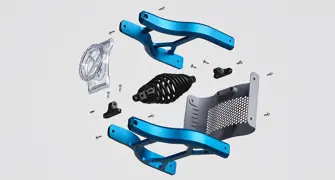
Fine-Tuning Tolerances for CNC Machined Parts
Maximize part quality, reduce cost, and navigate design challenges using standardized tolerances on machined parts
Key Points
- Tolerances are important in assemblies, but apply them sparingly and only where function requires.
- In general, tighter tolerances increase manufacturing, measurement and quality assurance cost.
- Keep it simple. For the majority of components, ±1 mm is sufficient for non critical features.
- In prototypes, adjust tolerances to validate what will be required in production.
- Use dimensionally stable materials where tight tolerance is important.
- Over stringent tolerances may require secondary processes and raise costs. Tolerances that are too loose can cause assembly issues. Understanding when to tighten or relax tolerances will optimise designs. Standardised tolerances improve quality, support fast iteration and reduce manufacturing cost.
Standardisation Achieved Through Tolerances Is Long-Standing but Essential for Global Trade
Component interchangeability and dimensional tolerancing are fundamental to modern manufacturing. The value of producing identical parts that fit any assembly of the same type dates back to 1841, and likely earlier. Sir Joseph Whitworth developed the British Standard Whitworth (BSW) thread form, which improved distributed manufacturing and enabled both competition and co-operation between different companies.
Perfection Can Hinder Progress
It is easy to apply tight tolerances and over constrain features with geometric dimensioning and tolerancing (GD&T) at the design and prototype stage. This will drive up manufacturing cost and limit sourcing options later in the development cycle. The most stringent tolerances may require secondary machining steps such as grinding, polishing or electrical discharge machining (EDM), increasing both cost and lead time.
Likewise, tolerances that are too loose can make assembly difficult or impossible.
To help navigate tolerance types and likely cost implications, this article covers tolerances available from Protolabs along with commonly used tolerances. Finally, we explore geometric dimensioning and tolerancing (GD&T), defined under BS 8888:2020, ISO and ASME.
Standardised Tolerances for CNC Machining
Many suppliers require a 2D drawing, sometimes to charge extra for the tightest tolerances while producing the rest of the component to a looser general tolerance (GT). Protolabs manufactures to a moderate standard tolerance of ±0.1 mm. Keeping it simple saves time on drawings and communication. For the majority of components this is sufficient: 54% of functional components can be manufactured to a tolerance of ±0.1 mm or less.

Tolerancing Guidelines for CNC Machining
Over constraining a design can take two forms: adding an unnecessarily tight tolerance, or constraining each degree of freedom more than once. A single pin constrains x and y, while a second pin prevents rotation. The same applies to slots and inserts, and over constraining will add cost.
Surface Finish
Protolabs typically delivers a 1.6 µm Ra (roughness average) surface finish across CNC machining materials. For general CNC machining, Ra 6.3 µm to Ra 0.8 µm is typical. Optional bead blasting produces a slightly rougher but uniform matt finish. See the surface finish guide for detailed images.
Designing In Adjustment
Adding adjustment features helps achieve an accurate fit and test the tolerances required:
- Shimming: Use thin shim steel or shim washers to set height or close gaps.
- Adjustment screws: Grub screws or fine pitch screws can alter position or push an assembly to a datum. Include a locking method such as a nylock nut, thread locking compound or a secondary screw.
- Press fitting: Press two components to a known height or position.
- Shrink fitting: Heat one component so thermal expansion locks the parts accurately.
Modification During Assembly
Bench fitting, fettling and polishing should be avoided for high volume production as they are skill dependent and introduce variation. In the test and prototype phase, using fine emery, lapping paste or polishing compound with rapid measurement helps iterate the design to the required tolerance. Another practical approach is to produce multiple design variants for assembly testing; CNC machining and 3D printing can quickly produce a test array.
What Are Microns?
The micrometre (µm) is one thousandth of a millimetre; a particle of cigarette smoke is about 1 µm in diameter. When holding your mobile, the warmth of your hand can change its size by up to 68 µm. This puts our general tolerance of ±100 µm into context. Avoid measuring in microns unless parts are normalised for 24 hours and measured in a temperature controlled environment using a CMM (which Protolabs offers). (Example: aluminium alloy CTE = 24 µm/m/°C; ambient 18 °C, body temperature 37 °C, phone length 150 mm.)
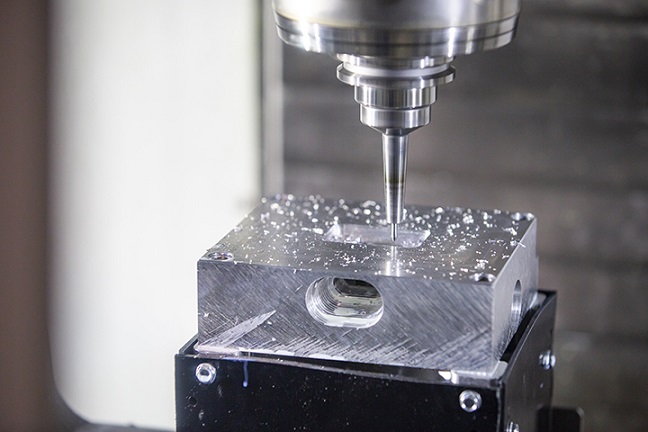
Quality Control and Documentation
Upon request, we measure using CMMs (coordinate measuring machines), laser scanning and other metrology equipment. We also support the Production Part Approval Process (PPAP), provide a Certificate of Conformance (CoC) to your specifications, First Article Inspections (FAIs) and material data sheets.
Capability and Measurement Accuracy
"Although Protolabs quoted ±0.1 mm on the aluminium parts, all dimensions were within ±0.05 mm." Customer comment.
Protolabs uses capability studies to maintain tolerance, so delivered parts often exceed the quoted tolerance, which covers multiple machining setups and material types. To achieve the best tolerance, follow this guidance:
- Where possible, orientate interrelated features to be machined in one plane so they are produced in the same setup.
- Use materials with a low coefficient of thermal expansion (CTE).
- Specify plastics with low moisture absorption. Water uptake changes size and shape and can affect CNC machined glass filled plastics.
Geometric Dimensioning and Tolerancing
GD&T gives designers a precise way to communicate critical manufacturing requirements to the manufacturer. It acts as concise notation; adding GD&T often specifies a sequence of manufacture and may imply a different process. Because it defines fit relationships between features, it increases the need for quality control, measurement and gauging.
Limits and fits: Normally defined on a hole basis to ISO 286-2, limits and fits use a letter and number with the hole diameter. Holes use a capital letter (for example H7) and shafts use a lowercase letter (for example g6). The larger the number, the wider the tolerance band:
- 9 and above: typical milled or drilled tolerance
- 7: generally a reamed hole; a specific reaming tool is needed for each size
- 6 and below: requires more specialised machining
The letter defines deviation from nominal. H is on nominal. k and higher are larger than nominal for an interference fit. g and lower are smaller than nominal for a clearance fit.
GD&T: A good course will explain how to apply and measure each tolerance class, with options from providers such as Mitutoyo, ImechE and NPL. How are geometric dimensions and tolerances achieved in manufacture?
True position: Most often shown with the diameter symbol to indicate the tolerance applied in every direction. It is absolute, so 0.030 equals ±0.015. Reamed holes are typically required, as an irregular hole diameter will consume the GD&T allowance. Calibrated CNC equipment and meticulous measurement setups are required.
Flatness: Milled surfaces are generally flat. Specifying very tight flatness usually implies surface grinding. Adding parallelism means two faces must be flat and aligned to each other. Surface finish is often specified and will consume part of the measurement tolerance. Tip: use slightly raised pads or mark only the areas where flatness is critical on the drawing to simplify manufacture and measurement.
Cylindricity, concentricity and run-out: These apply to holes and shafts. Run-out is often specified because it is easier to measure. A dial test indicator (DTI) records deviation as the workpiece is rotated. Run-out is a compound measurement, so further checks may be needed to confirm cylindricity (not out of round) or concentricity (on the centre of rotation).
Squareness (perpendicularity and angularity): CNC milling machines are calibrated to ensure tools are square to the machine bed, which delivers good squareness, especially over short distances. The tighter the squareness tolerance, the more iterative and time consuming the manufacturing will be.
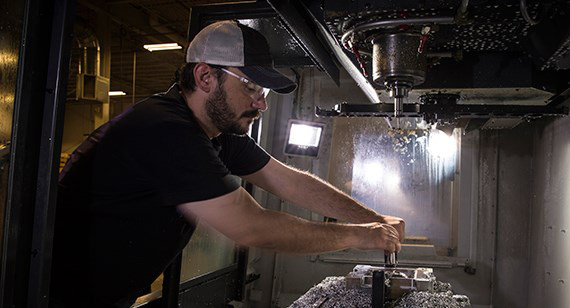
It is important to understand tolerances and GD&T and use them appropriately. It is easy to add them to a drawing, but always consider whether they are needed, as they can be difficult for your manufacturing supplier and will add cost. We can quote and manufacture quickly from your CAD model, and a physical part is often the best way to assess how a design will fit together.
We are here to support your project. Just give us a call or send an email if you want to know more. We always have applications engineers available to assist with any questions at [email protected] or +44 (0) 1952 683047. Ready to start your next project? Just upload a CAD file to our website.
Get a Quote
Ready to set tolerances for your CNC machined parts? Upload your part design to receive an instant quote with standard and precision tolerance options.


