

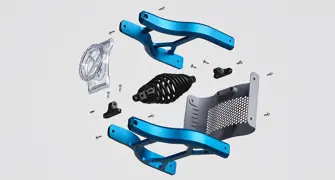
Aluminium 3D Printing Service
3D-printed aluminium offers high temperature and corrosion resistance and an excellent strength-to-weight ratio
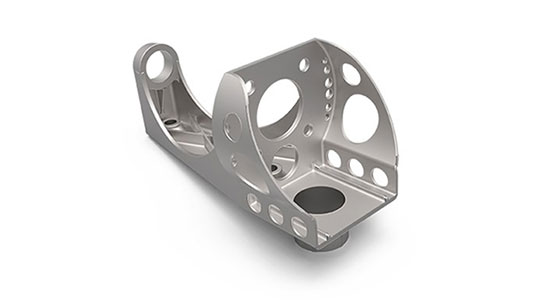
Aluminium (AlSi10Mg) is comparable to a 3000 series alloy that is used in casting and die casting processes. It has good strength-to-weight ratio, high temperature and corrosion resistance, and good fatigue, creep and rupture strength. AlSi10Mg also exhibits thermal and electrical conductivity properties. Final parts built in AlSi10Mg receive stress relief application.
Primary Benefits
- High stiffness and strength relative to weight
- Thermal and electrical conductivity
- High temperature and corrosion resistance
Aluminium (AlSi10Mg) Material Properties
|
|
Condition | Ultimate Tensile Strength | Yield Stress | Elongation | Hardness | Learn More |
|---|---|---|---|---|---|---|
| Aluminium (AlSi10Mg) |
No Heat Treated | 360+/- 30 MPa | 240+/- 30 MPa | 6 +/- 5% | 120 +/- 5 HBW | Data Sheet |
| Heat Treated | >267 MPa | >200 MPa | 10 +/- 2% | - |
*All of the figures contained on this data sheet are approximate and dependent on a number of factors, including but not limited to, machine and process parameters. The information provided is therefore not binding and not deemed to be certified
3D-Printed Aluminium Part Dimensions
Maximum part size and minimum feature size will vary based on selected resolution. 3D-printed aluminium is available in high, normal, and large format resolutions.
| Resolution | Metric | |
| Maximum Dimensions | High (30 μm) | 250 mm x 250 mm x 300 mm |
| Normal (60 μm) | 250 mm x 250 mm x 300 mm | |
| Minimum Feature Size | Normal & High | 1 mm |
Applications for 3D-Printed Aluminium
Due to its high strength-to-weight ratio, 3D-printed aluminium is frequently used in the automotive and aerospace industries for parts such as:
- Gearboxes
- Housings
- Brackets
- Heat exchangers
- Engine parts


