
Chromate Conversion
Corrosion-resistant, electrically conductive aluminium parts, finished and shipped in as fast as 5+ business days.

What is Chromate Conversion Coating?
|
Chromate conversion coating is a type of chemical conversion process used to passivate aluminium alloys. The treatment modifies the surface of the metal itself rather than adding a separate layer. It is primarily used as:
This combination of properties makes chromate conversion a common choice in electronics, aerospace, automotive, industrial equipment and other high-performance applications. |
Benefits of Chromate Conversion

Helps prevent corrosion
Forms a protective conversion layer on aluminium to improve resistance in demanding environments.
Retains conductive properties
Maintains the electrical conductivity of aluminium, making it suitable for enclosures, grounding components and EMI shielding applications.
Excellent paint base
Provides a robust base layer for paints, lacquers and powder coatings, improving adhesion and coating durability.
Thin, dimensionally stable coating
Minimal impact on critical dimensions compared to thicker coating systems.

Chromate Conversion Service in Protolabs
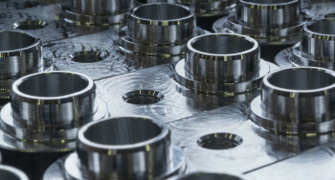
Protolabs’ chromate conversion service provides reliable corrosion protection, excellent paint adhesion, and preserved electrical conductivity for aluminium components. Offered as a convenient post-processing option alongside our CNC machining service, Surtec 650 finishing allows you to receive fully machined and passivated parts in just a few days. With fast lead times, no minimum order quantities, and automated quoting, it’s easy to go from CAD to chromate-converted production parts quickly and efficiently.
Capabilities of Chromate Conversion
| We currently offer chromate conversion for a selection of commonly used engineering-grade aluminium alloys: |

Aluminium 6082
Good strength and machinability for structural components.
Aluminium 7075
High-strength alloy often used in aerospace and performance applications.
Aluminium 2024
Strong, fatigue-resistant alloy suitable for aerospace and transportation.
![]() Design considerations
Design considerations
 Design considerations
Chromate conversion coatings are thin, but features such as sharp edges, blind holes and deep pockets can influence coating uniformity. Our automated DFM feedback can highlight potential issues early in the quoting process.
Why Combine CNC Machining and Chromate Conversion Coating with Protolabs?

Fast Turnaround
Get fully finished CNC parts just +5 days after CAD upload, keeping development cycles short and production moving.

Flexible Across Many Geometries
We support a wide range of part geometries, from simple brackets to complex housings, depending on material and design.

Simple Vendor Management
Upload your CAD model, choose machining with Surtec 650 finishing, and receive completed parts from one supplier.

Consistent Quality
Digital quoting, DFM feedback and repeatable production help ensure a consistent finish from prototype to low-volume production.
FAQs
What is chromate conversion coating?
expand_less expand_moreChromate conversion is a chemical process that passivates aluminium by forming a thin, protective conversion layer. It enhances corrosion resistance, improves paint adhesion, maintains electrical conductivity, and provides a clean, stable surface finish.
What type of chromate conversion do you offer?
expand_less expand_moreProtolabs offers Surtec 650, a hexavalent chromium–free passivation process suitable for alloyed and cast aluminium. It provides low contact resistance and is ideal as a pretreatment for painting, powder coating, or bonding.
Which aluminium materials are compatible with chromate conversion?
expand_less expand_moreWe currently support chromate conversion for the following alloys:
- Aluminium 6082
- Aluminium 7075
- Aluminium 2024
These grades are commonly used in aerospace, electronics and industrial applications.
How thick is the chromate conversion coating?
expand_less expand_moreThe coating is very thin, typically measured in microns, so it has minimal impact on tight tolerances or critical dimensions. This makes it ideal for precision-machined components.
How long does the chromate conversion process take?
expand_less expand_moreTypical lead times start from 5+ business days, depending on part complexity, order quantity and any additional services such as machining or inspection.
Does chromate conversion improve electrical conductivity?
expand_less expand_moreYes. Unlike many protective coatings, chromate conversion maintains low contact resistance, making it suitable for grounding points, EMI shielding components and electrical enclosures.
Can chromate-converted parts be painted or powder coated?
expand_less expand_moreAbsolutely. Chromate conversion provides an excellent base layer for paint, lacquer, powder coating and adhesives. Surtec 650 is specifically formulated to improve coating adhesion.
What industries commonly use chromate conversion?
expand_less expand_moreChromate conversion is widely used in:
- Aerospace
- Electronics
- Automotive
- Industrial equipment
- Defence and instrumentation
Anywhere that requires corrosion resistance without sacrificing conductivity.
Can I combine CNC machining and chromate conversion in one order?
expand_less expand_moreYes. Protolabs provides machining and chromate conversion as integrated services. Simply upload your CAD model, choose chromate conversion as your finish, and receive completed parts from a single supplier.