

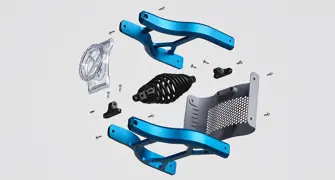
PEEK Plastic: Key Benefits & Applications
For applications requiring strength, heat resistance, and chemical stability, PEEK is a high-performance plastic commonly used in CNC machining and injection moulding.

What is PEEK?
|
PEEK (polyether ether ketone) is a semi-crystalline, high-performance thermoplastic designed for demanding environments where standard engineering plastics fall short. It offers a unique combination of mechanical strength, thermal stability, and chemical resistance, making it a common alternative to metal in weight-sensitive or high-temperature applications. |

Benefits of PEEK
PEEK delivers a balance of performance characteristics that make it suitable for both functional prototypes and end-use parts. It maintains mechanical strength at elevated temperatures and resists a wide range of chemicals, including fuels, oils, and solvents. Its low moisture absorption supports dimensional stability, even in harsh environments.
The material also offers strong wear and abrasion resistance, making it well suited for components subject to friction or repeated motion. In regulated industries, PEEK can be sterilised and meets requirements for medical and aerospace applications.
Protolabs’ PEEK Capabilities
Protolabs offers PEEK for both CNC machining and injection moulding, with the following capabilities:
PEEK for CNC Machining
CNC machining is ideal for quick-turn prototyping and low-volume production using PEEK, especially for parts requiring tight tolerances and thermal stability.
| Capability | Details |
| Best for | Prototypes and low-volume parts requiring high strength and heat resistance. Fast turnaround with excellent dimensional control |
| Tolerance | Aligns with ISO 2768-medium unless otherwise specified |
| Wall thickness | Can accommodate thinner walls than injection moulding depending on part geometry, though stiffness and machining constraints should be considered |
| Colour options | Typically available in natural (beige) and black. Additional grades (filled PEEK) available on request |
| Surface finish | As-machined finish, typically smooth to slightly matte depending on tooling and cutting parameters |
| Machining considerations | Higher tool wear and material cost compared to standard plastics; fixturing may be required for precision parts |
| Data sheets | PEEK |
PEEK for Injection Moulding
For higher volumes, injection moulding offers repeatable PEEK parts with consistent performance and quality.
| Capability | Details |
| Best for | Medium- to high-volume production parts requiring high strength, chemical resistance, and thermal stability |
| Tolerance | Typically ±0.05 mm (±0.002 in), depending on geometry and tooling |
| Wall thickness | Requires uniform wall thickness for optimal flow and reduced warping; thicker sections may be needed compared to CNC |
| Colour options | Natural (beige) is standard; custom colours may be available depending on grade and volume |
| Surface finish | SPI mould finishes available, ranging from matte to polished cosmetic surfaces |
| Processing considerations | High processing temperatures and controlled drying required; typical mould shrinkage ~1% |
| Data sheets | Victrex PEEK 450G |
Manufacturing with PEEK
| PEEK parts are usually manufactured using CNC machining and injection moulding, depending on geometry and production volume. |
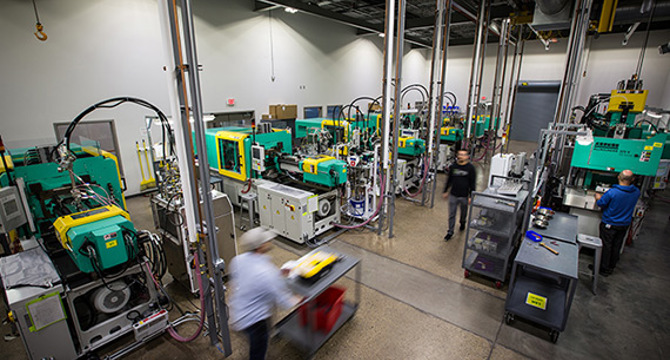
Injection Moulding with PEEK
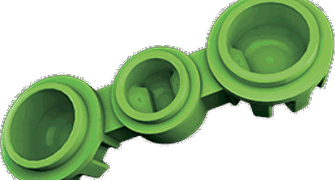
Injection moulding is well suited to higher-volume PEEK production, delivering consistent part quality and repeatable mechanical performance. Due to its high processing temperatures and material cost, designs should be optimised for manufacturability early in development.
Design Guidelines
- Maintain uniform wall thickness to support proper flow and minimise internal stresses
- Avoid thick sections that can lead to longer cooling times and potential warping
- Incorporate draft angles to support part ejection
- Design ribs and bosses carefully to reinforce parts without creating sink or stress points
- Consider gating and flow early, as PEEK requires precise processing conditions

CNC Machining with PEEK
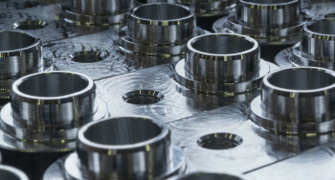
CNC machining is best for quick-turn prototypes or low-volume PEEK parts that require high strength, heat resistance, and tight tolerances. It supports complex geometries and functional features, though the material’s stiffness and cost require careful design to optimise machinability and reduce waste.
Design Guidelines
- Avoid unnecessary material removal. Efficient part geometry helps control cost
- Use fillets and radii instead of sharp internal corners to improve tool life and reduce stress concentrations
- Maintain consistent wall thickness for dimensional stability
- Account for heat buildup during machining, especially in thicker sections
- Plan for fixturing on complex or high-precision parts to maintain accuracy
Advantages and Disadvantages of PEEK
Advantages
|
Disadvantages
|
PEEK Compared to Other Thermoplastics
| PEEK is a high-performance thermoplastic often compared with other engineering and high-temperature plastics. Here’s a comparison of key properties. |
Applications
PEEK is used across industries where performance requirements exceed standard thermoplastics:
|


