
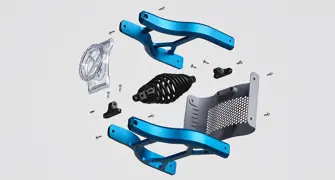
Advantages and Disadvantages of Stereolithography (SLA) 3D Printing
This guide breaks down the benefits and drawbacks of SLA 3D printing so you can decide when it’s the right choice.
Stereolithography (SLA) is a vat‑photopolymerisation process, using a UV laser to cure liquid resin layer by layer, building a part. Engineers choose SLA for fine‑feature prototypes and fixtures where surface finish and dimensional accuracy matter most. This article summarises the benefits and the trade‑offs so you can decide when SLA is the right fit versus other 3D printing processes such as SLS and MJF.
The Stereolithography Process
The SLA process uses a laser to cure liquid photopolymer resin into solid layers with extreme precision. After each layer is cured, the build platform moves by one layer thickness, fresh resin is spread, and the next layer is cured. This continues layer by layer until your 3D part is complete.
Supports are required and may leave small surface marks where they were attached. After printing, parts are rinsed, UV post‑cured and, if needed, finished (sanding, bead blasting, painting or clear‑polish).
There are two common printer configurations: bottom-up (inverted) systems, which are more compact and use less resin, and top-down systems, which can build larger parts but require more resin. Both use the same basic principle of layer-by-layer curing.
Advantages of Stereolithography
SLA delivers smooth, near‑moulded surfaces and tight, repeatable dimensions. If you need cosmetic parts, accurate fit checks, intricate details or small fixtures, these are the strengths to expect:
- Fast turnaround: Lead times as fast as one business day.
- High accuracy: Tolerances of ±0.05mm in X/Y axes and ±0.13mm in Z axis.
- Excellent surface finish: Smooth, near-moulded surfaces.
- Cost-effective prototyping: Ideal for detecting design flaws before expensive tooling or manufacturing.
- Clear and speciality resins: Clear, tough, high-temperature, and speciality resins. Explore our complete SLA materials guide for detailed properties.
- Complex geometries: Build multi‑part assemblies from CAD to check fits and tolerances.
- Micro-resolution capability: MicroFine materials for incredibly detailed parts.
- Easy scaling: CAD-driven process makes design changes quick and simple so it is simple to move from prototyping to production.
- Snap-together assemblies: Print components that fit together to check interfaces and tolerances. It’s easy to tweak the CAD and reprint, making SLA ideal for iterative form‑and‑fit testing.
Limitations of Stereolithography
While SLA offers impressive capabilities, it's important to understand its limitations to make informed decisions:
- Limited material choice: Fewer options compared to other 3D printing technologies like SLS or MJF. Check our comparison guide between SLA and SLS for specifics.
- Extensive post-processing: Every part needs cleaning, support removal, and often additional UV curing. Mandatory support structures: Supports leave marks, consume material, and limit part orientation options.
- Material brittleness: Photopolymers are generally more fragile than engineering thermoplastics.
- UV sensitivity: Parts degrade with sunlight exposure, causing brittleness and discolouration.
- Limited mechanical properties: Lower strength compared to SLS nylon or MJF parts for functional applications.
- Higher material costs: Resins are more expensive than thermoplastic filaments.
- Not suitable for outdoor use: UV photosensitivity makes long-term exterior applications challenging.

Why Choose Protolabs for SLA
While SLA technology itself offers impressive capabilities, our approach to delivering SLA services sets us apart from the competition:
- Instant automated quoting: Get pricing and lead times immediately when you upload your CAD file.
- One business day turnaround: Streamlined production workflow gets parts in your hands fast.
- Expert material selection: Our application engineers guide you to the optimal SLA resin for your specific application.
- Automated DFM analysis: Every quote includes comprehensive design checks that flag potential issues before production.
- Consistent quality: Calibrated systems ensure repeatable tolerances and surface finish batch after batch.
- No minimum orders: Scale from single prototypes to low-volume production runs without setup fees.
- Application engineering support: Decades of experience helping engineers navigate material selection and design optimisation.
- MicroFine™ expertise: Specialised knowledge in micro-resolution parts for medical and electronics applications.
- Large and small builds. Industrial platforms support both large cosmetic prototypes (up to 736×635x533 mm on our SLA platform) and very small parts with fine detail (down to ~0.07 mm with MicroFine).
SLA is a strong choice for cosmetic parts, form‑and‑fit checks and high accuracy with an excellent surface finish. While we’re experts in SLA, we also offer five other 3D printing technologies—SLS, MJF, DLS, PolyJet and DMLS—so we can recommend the best process for your part. For some projects, you may find that CNC machining or on‑demand injection moulding is the better route.
SLA vs Other 3D Printing Technologies
Choosing the right technology means understanding how they stack up against each other. Here's how SLA compares to the alternatives.
|
Technology |
Typical Tolerance |
Layer Height (mm) |
Min Feature (mm) |
Max Build (mm, XYZ) |
Surface Finish |
Best For |
|
±0.05–0.10 mm + 0.001 mm/mm (X/Y); ±0.13 mm + 0.001 mm/mm (Z) |
0.025–0.10 |
0.07–0.25 (XY) |
736 × 635 × 533 |
Smooth, near‑moulded |
Cosmetic prototypes, fine detail, clear parts |
|
|
±0.20 mm + 0.002 mm/mm (TPU ±0.30 mm) |
0.1 |
0.75–1.00 |
676 × 367 × 564 |
Grainy/matte |
Functional nylon parts, snap‑fits, jigs |
|
|
±0.25 mm + 0.002 mm/mm (TPU ±0.30 mm) |
0.08 |
0.5 |
284 × 380 × 380 |
Matte, finer than SLS |
Production‑ready nylon with consistent properties |
|
|
±0.25 mm (first 25.4 mm) + 0.1% of length |
0.1 |
0.50 (holes 0.60) |
400 × 250 × 460 |
Smooth |
Durable, production‑like polymers |
|
|
±0.10 mm + 0.001 mm/mm |
0.03 |
0.8 |
490 × 390 × 200 |
Very smooth |
Elastomeric prototypes, overmoulding simulation |
|
|
±0.10–0.20 mm + 0.005 mm/mm |
0.02–0.06 |
0.50–1.00 |
up to 300 × 300 × 380* |
As‑built 4–10 µm Ra |
End‑use metal parts |
3D Printing Process Quick Guide
Use this quick guide to choose the right 3D printing technology based on your requirements.
- Smoothest surface, fine detail, clear/translucent options → SLA
- Durable nylon for snap‑fits, jigs and fixtures → SLS
- Consistent, production‑ready nylon with fine features → MJF
- Elastomers (30A–95A) and silicone (60–65A) → PolyJet
- Smooth, production‑like polymers with strong cosmetics → DLS
- End‑use metal parts → DMLS
- Lowest‑cost drafts and simple functional parts in common filaments → FDM (offered by Protolabs Network)
For a deeper look at SLA vs. SLS, see this side-by-side comparison.
When to Choose SLA
Use SLA when surface quality and dimensional accuracy are your top priorities. Start with this checklist.
- Cosmetic quality and tight dimensions matter most.
- You need fine features, thin walls or micro‑resolution details.
- You want clear or translucent parts without tooling.
- You need fast iterations on appearance models.
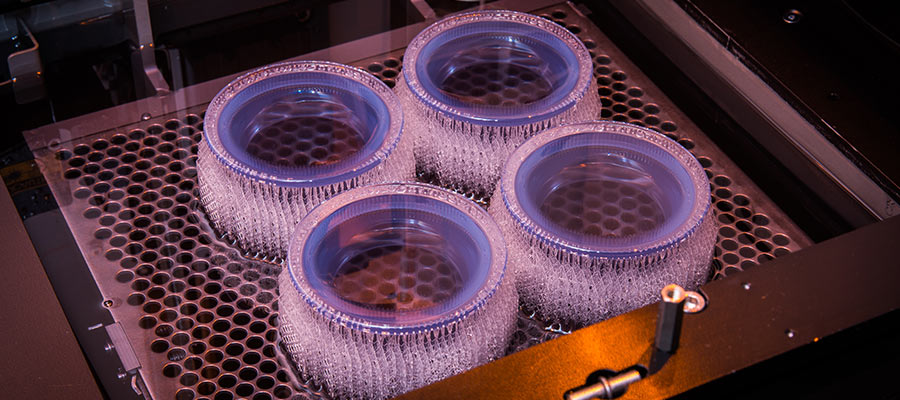
Common Applications of SLA
SLA finds its home across diverse industries, each leveraging its unique strengths:
- Medical and dental: Anatomical models, guides and housings where accuracy and surface quality are important.
- Consumer electronics: Cosmetic enclosures, light‑pipes (with clear finishing) and small mechanisms for fit checks.
- Automotive and aerospace: Design validation models, aerodynamic/flow visualisation, and ergonomic bucks.
- Industrial equipment: Fixtures, assembly aids and patterns for downstream processes.
Design Guidelines for SLA
Getting the most from SLA requires understanding how it works and designing accordingly:
- Keep wall thicknesses consistent to avoid warping and dimensional distortion.
- Orient parts strategically to minimise support structures and improve surface quality on critical faces.
- Use fillets to strengthen corners and reduce stress concentrations.
- Plan for post-curing requirements when specifying tight tolerances. Parts can shrink slightly during final curing.
- Design with support removal in mind. Avoid delicate features in hard-to-reach areas.
Need more guidance? Check our comprehensive design tips resource and design for 3D printing toolkit for detailed recommendations.
FAQ
How accurate are SLA parts?
expand_less expand_moreSLA offers tight, consistent tolerances for well-designed parts. For current figures by resolution, see SLA capabilities.
What is the maximum part size?
expand_less expand_moreIndustrial SLA supports very large prototypes as well as micro parts. Check the latest build volumes on the SLA service page.
How clear can SLA be?
expand_less expand_moreWe can produce translucent to near-clear parts with the right resin and finishing. If you need optical clarity, mention it in your quote request so we can recommend the best combination.
Are SLA parts suitable for outdoor use?
expand_less expand_more
|


