
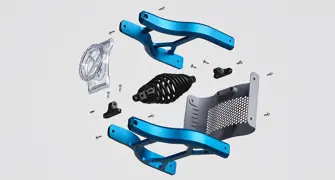
Injection moulding – What are the advantages and disadvantages?
Injection moulding offers several advantages. It minimises unit cost and provides a highly repeatable way to producing plastic or elastomeric parts with high precision. Once the tool is set up, it can manufacture a high volume of parts per hour in a wide range of different plastics, as well as materials such as liquid silicone rubber.
However, like any manufacturing process, it does have some disadvantages, and if these prove significant to the success of your project, then you may be better off exploring alternative manufacturing technologies such as 3D printing or CNC machining.
In this guide, we outline the main advantages of injection moulding and when it may be appropriate to consider an alternative production method.

What are the advantages of Injection Moulding?
1. Efficient high production
Once the moulds are developed, cycle times can be as short as 10 seconds. Injection moulding is well suited to medium and high-volume production, from about 10,000 parts to well over 100,000, depending on the mould design and material.
Throughput can be increased with multi-cavity or family moulds, where several parts are produced in a single press cycle.
For outsourced moulding, an efficient front-end design and ordering process helps reduce lead time and cost. See our on-demand manufacturing.
2. Low cost per part
For high output production runs, the cost per part is very low. For medium volumes in the range of 10,000 to 25,000 parts, costs can be reduced by using aluminium moulds instead of steel.
3. Repeatability
Identical parts are produced consistently. This is ideal when tight tolerances and reliability are required across high volumes.
4. Large material choice
A wide range of plastics is available to meet specific performance requirements, and Protolabs also offers liquid silicone rubber moulding. Fillers can be added to increase strength, and a broad selection of colours is available. Multiple material options typically meet the same performance target.
5. Low waste
Injection moulding generates very little waste compared to many other manufacturing processes. Unused or excess plastic can often be recycled for future use.
6. High detail
Molten plastic is injected into the mould under high pressure, forcing the material against the tool surface. This supports complex geometries and fine detail.
7. Little or no post processing
Minimal post-processing is usually required, as moulded parts often have good aesthetics straight from the tool. Tooling can be produced with specific textures or finishes that appear on the moulded part, and logos or text can be engraved.
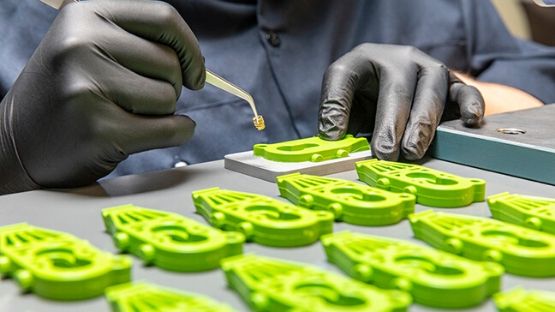
What are the disadvantages of Injection Moulding?
When should you consider alternative manufacturing methods to injection moulding?
1. Initial cost
Committing to steel mould tools for high production volumes (100,000+) requires significant time and machining, which drives capital cost. For lower volumes, this increases cost per part, so alternatives such as aluminium moulds may be more suitable.
2. Initial lead times
Steel tooling can take up to 12 weeks to produce. If production needs to start sooner, our on-demand production uses aluminium moulds and a digitised front end to ship 25 to 10,000+ parts in 15 working days or less from initial CAD upload. In some cases, parts ship in as little as one day.
For very low volumes, 3D printing or CNC machining can provide a faster, more cost-effective route.
3. Design limitations
Specific design elements require attention:
- Use draft and radii to aid part ejection
- Avoid undercuts and sharp edges
- Control wall thicknesses
Gate, ejector and cooling line placement also affects aesthetics. Mould design changes are limited. Material can be removed from the tool to add plastic to the part, but the reverse is not feasible.
For smaller runs, 3D printing allows almost any geometry and supports an expanding range of plastics and metals.
4. Small part runs are not always cost effective
While injection moulding is often associated with 100,000+ parts, there are options for smaller batches.
Using more affordable aluminium moulds and fast turnaround, our on-demand service helps reduce cost per part. It is ideal for 10,000 to 25,000 parts and can help control costs for even smaller runs.
For quantities in the hundreds or fewer, 3D printing and CNC machining often offer lower unit costs without tooling setup or long lead times.

Injection moulding is an excellent method for mid to high volumes in plastic and liquid silicone rubber. As the technology evolves, new approaches can reduce part cost for smaller runs. It is also worth assessing whether CNC machining or 3D printing is a better fit for small batches or custom parts.
As a digital manufacturer, we can help you select the right process.
Upload your CAD to get started.
Need help?
Schedule a free design review.


