
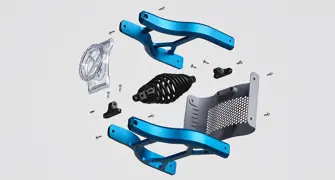

Nylon parts are used widely, but when standard nylon is not tough enough, glass filled nylon is a good candidate. This polyamide engineering plastic offers higher strength, stiffness and heat resistance by adding powdered glass to nylon resin or compounding nylon with glass fibres. For powder bed 3D printing, glass spheres are blended into the base nylon powder at defined percentages. While glass reinforcement improves rigidity and thermal stability, it increases density and can reduce impact toughness, so selection should match the load case and manufacturing process.
Advantages of Glass-Filled Nylon
Adding glass reinforcement makes nylon substantially stronger, harder and more rigid. It also improves creep resistance, dimensional stability and wear resistance, and allows higher maximum service temperatures. Primary benefits compared to standard unfilled nylon include:
- Considerably higher hardness
- Superior tensile strength
- Greater stiffness
- Substantially lower thermal expansion
- Increased stability under temperature fluctuation
- Lower creep rate
- Good fatigue strength
- High mechanical damping properties
- Suitable for parts requiring high static loads at elevated temperatures
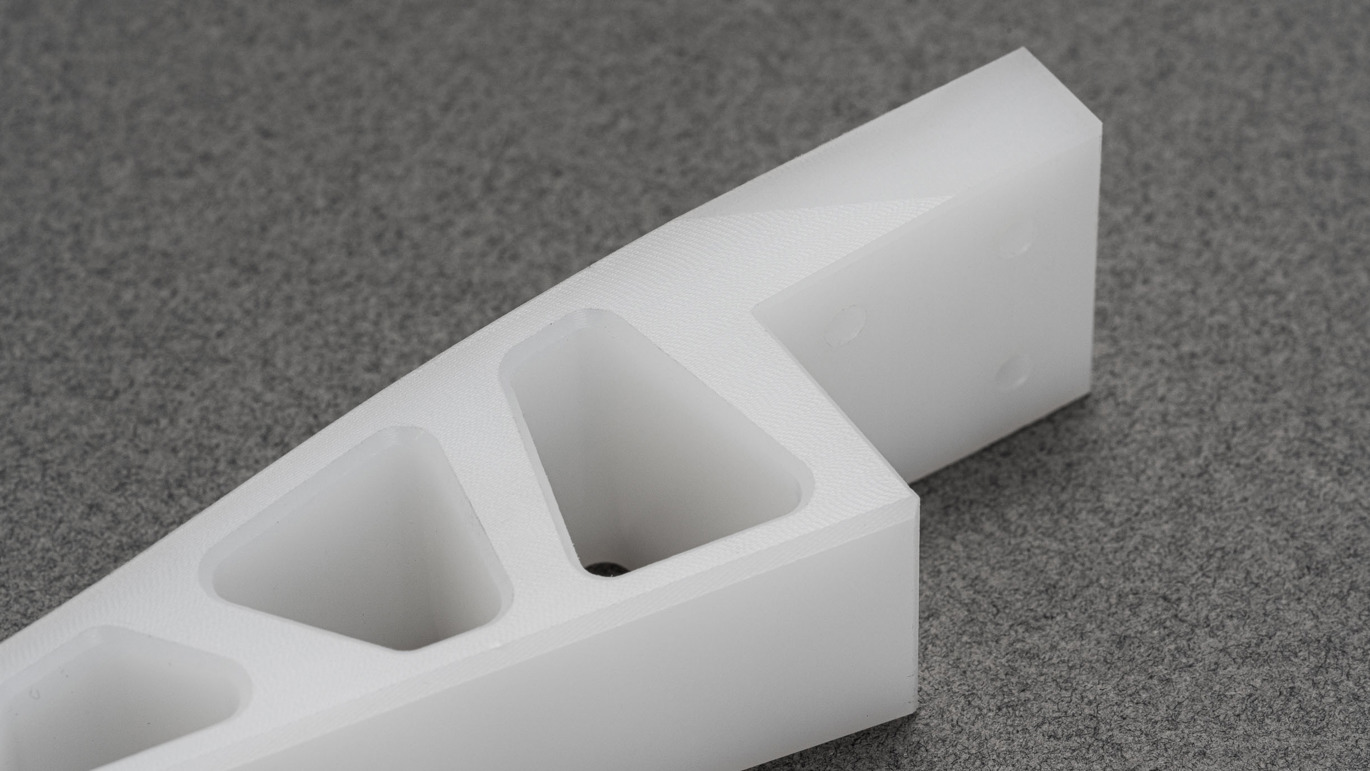
Disadvantages of Glass-Filled Nylon
Every material involves trade offs. Consider these drawbacks when selecting glass filled grades for engineered parts:
- Substantially higher cost
- More brittle
- Abrasive to tooling, causing increased tool wear
- Can abrade mating parts due to higher friction
- Heavier than standard nylon
- Significantly weaker weld lines
- Anisotropic properties and shrinkage
Benefits of Using Glass-Filled Nylon for Machined Parts
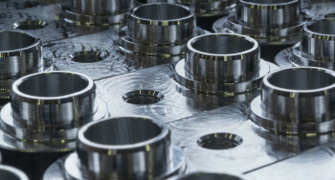
Nylon is a strong choice for CNC machined components that experience friction and wear. Glass filled nylon is more demanding to machine because the glass fibre reinforcement is highly abrasive, which can accelerate wear on cutting tools and inserts. With appropriate tool selection, feeds, speeds and coolant control, engineers can achieve reliable results in outsourced CNC machining.
When specified correctly, glass filled nylon provides good mechanical properties, fatigue resistance, noise damping, and bearing and wear performance, with higher stiffness and thermal stability than unfilled grades. We machine Nylon 6 and Nylon 6/6 (30% GF) black.

Benefits of Glass-Filled Nylon for 3D-Printed Parts
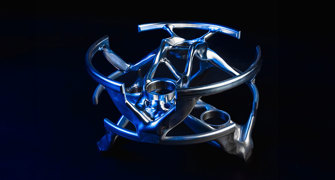
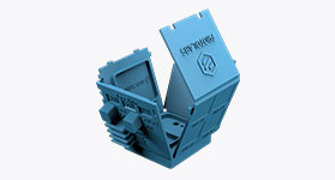
Nylon materials produce strong, durable parts suitable for functional prototyping and end use. A wide range of nylon grades can be used with selective laser sintering (SLS) and Multi Jet Fusion (MJF). While all printed nylons offer high strength, stiffness and temperature resistance, glass filled grades provide longer wear life, higher stiffness and substantially greater heat deflection resistance. We manufacture glass filled nylon parts in PA 12 Glass Beads, which is grey. The chart below compares key differences between nylons used in 3D printing.
Comparing Filled Nylon Material Properties
| Material | Process | Colour | Tensile Strength | Tensile Modulus | Elongation | Heat Deflection Temp. @ 0.46 MPa | Heat Deflection Temp. @ 1.82 MPa | Provided by |
|---|---|---|---|---|---|---|---|---|
| PA 12 Glass Beads Smooth Grey | MJF | Grey | 30 MPa | 2,500 MPa | 10% | 174° C | 114° C | Protolabs Factory |
| PA 12 Smooth Light Grey (Unfilled) | MJF | Grey | 47 +/- 4 MPa | 1,900 +/- 200 MPa | 9 +/- 4% | 175° C | 95 ˚C | Protolabs Factory |
With MJF, PA 12 Glass Beads (smooth grey) is commonly used to build housings, enclosures and fixtures. It also suits snap-fit and complex assemblies, and is effective for watertight and airtight applications and biocompatible parts.
Benefits of Glass-Filled Nylon for Injection-Moulded Parts
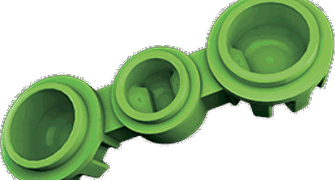
Moulded nylon offers good hardness, stiffness and rigidity, but standard grades have limited heat resistance and poor UV performance. Adding glass fibres improves these properties, increasing high temperature strength, dimensional stability and wear resistance. In injection moulding, glass filled nylon also improves chemical resistance, except when exposed to strong acids and bases.
- Gerbamid B GF 30 (Repro) 100% recycled content (Black 30% Glass Fibre rPA6)
- Radilon BGV 30 30% Glass Fibre Natural
- Radilon S RV300 (30% Glass Filled) Black
- Techanyl A 20 V25 25% Glass Fibre Black
- Zytel 70G30HSLR 30% Glass Fibre Black
- Latamid 66 H2 G/25-VOKB1 25% Glass Fibre (Black)
Glass filled nylon is electrically non conductive, making it suitable as an insulating shield for electrical and automotive applications. Additional benefits for injection moulding include:
- Increased rigidity
- Improved hardness
- Superior tensile strength
- Increased creep resistance
- Greater dimensional stability
- High mechanical damping
Nylon, and especially glass filled nylon, can be more susceptible to warpage due to non-linear shrinkage, so selecting the right grade for the application is essential. In humid environments, nylon is hygroscopic and absorbs moisture, which can cause dimensional and structural issues. Glass fill can also introduce dimensional challenges in semi-crystalline materials, so there are trade offs to consider.
Get Started
Ready to spec glass filled nylon? Upload your part design to receive an instant quote with material options and recommendations.


