
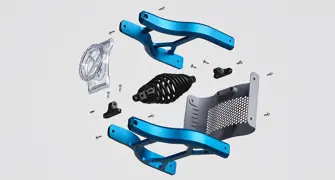

3D printing covers several manufacturing processes used by engineers to build parts layer by layer. These processes vary in how they form plastic and metal components, and in material selection, surface finish, durability, lead time and cost.
There are several types of 3D printing, which include:
- Stereolithography (SLA)
- Selective Laser Sintering (SLS)
- Fused Deposition Modeling (FDM)
- Digital Light Process (DLP)
- Multi Jet Fusion (MJF)
- PolyJet
- Direct Metal Laser Sintering (DMLS)
- Electron Beam Melting (EBM)
Selecting the right 3D printing process for an engineering application requires understanding each process’s strengths and limitations and mapping them to product development needs. This guide outlines how 3D printing fits within the product development cycle, then reviews common 3D printing technologies and the advantages of each for outsourced manufacturing.
3D Printing for Rapid Prototyping and Beyond
3D printing is most often used for prototyping. The ability to produce a single part quickly allows design engineers to validate and share concepts at low cost. Define the purpose of the prototype to select the most suitable 3D printing process. Additive manufacturing supports prototypes from simple visual models to parts for functional testing.
Although 3D printing is closely associated with rapid prototyping, it can also be a viable production method. Suitable applications typically involve low volumes and complex geometries. Aerospace and medical components are often good candidates for production additive manufacturing because they meet these criteria.

Five 3D Printing Considerations
Selecting a 3D printing process rarely has a single answer. When we support engineers evaluating options, we focus on five key criteria to match the technology to application requirements:
-
Budget
-
Mechanical requirements
-
Cosmetic appearance
-
Material selection
-
Geometry
Polymer 3D Printing Processes
This section outlines common plastic 3D printing processes and when each delivers the most value for product developers and engineers in outsourced manufacturing.
Stereolithography (SLA)
Stereolithography is the original industrial 3D printing process. SLA produces parts with high detail, smooth surface finish and tight tolerances. The high quality finish can aid function, for example when testing assembly fit. It is widely used in medical applications, including anatomical models and microfluidics. We manufacture SLA parts on 3D Systems Viper, ProJet and iPro machines.
Selective Laser Sintering (SLS)
Selective laser sintering (SLS) fuses nylon-based powder to form solid plastic parts. Because SLS uses true thermoplastic, parts are durable, suitable for functional testing, and can support living hinges and snap-fits. Compared with SLA, parts are stronger but have a rougher surface finish. SLS does not require support structures, so the full build volume can be utilised to nest multiple parts in a single run, making it suitable for higher part quantities than many other 3D printing processes. Many SLS parts prototype designs that will later be injection moulded. We produce SLS parts on 3D Systems sPro 140 machines.

PolyJet
PolyJet is a plastic 3D printing process that can build parts with multiple materials and colours in a single print. Engineers use it to prototype elastomeric, overmoulded and multi-material components, including varying Shore hardness. For single, rigid plastic prototypes, SLA or SLS is usually more economical. For overmoulding or silicone rubber designs, PolyJet enables realistic prototypes without early tooling, allowing faster iteration and validation in outsourced manufacturing.
Digital Light Processing (DLP)
Digital light processing is similar to stereolithography in that it cures liquid resin using light. The key difference is that DLP uses a digital light projector, while SLA uses a UV laser. Imaging an entire layer at once increases build speed. While often used for rapid prototyping, the higher throughput makes DLP suitable for low volume production of plastic parts.
Multi Jet Fusion (MJF)
Similar to SLS, MJF builds functional nylon parts from powder. Instead of a laser, an inkjet array deposits fusing agents onto the powder bed, then a heating element fuses each layer. This delivers more consistent mechanical properties than SLS and an improved surface finish. Faster build times reduce production cost, making MJF well suited to low volume batches and functional prototypes for engineers.
Fused Deposition Modelling (FDM)
Fused deposition modelling is a widely used 3D printing process for plastic parts in prototyping and tooling. The printer extrudes thermoplastic filament layer by layer onto the build platform. For engineers, FDM offers a fast, cost-effective way to produce physical models and basic functional prototypes. Limitations include relatively rough surface finish and lower strength compared with other processes.
Metal 3D Printing Processes
Direct Metal Laser Sintering (DMLS)
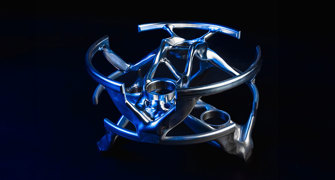
Metal 3D printing supports complex metal part design for engineers. We manufacture metal parts using direct metal laser sintering (DMLS). DMLS consolidates multi-part assemblies into a single component and produces lightweight structures with internal channels or hollowed-out features. Parts are fully dense and comparable to machining or casting, so DMLS suits both prototyping and production. The ability to create complex geometries also makes it suitable for medical applications where designs must mimic organic structures.
Electron Beam Melting (EBM)
Electron beam melting is a metal 3D printing process that uses an electron beam, controlled by electromagnetic coils, to melt metal powder layer by layer. The build chamber operates under vacuum and the powder bed is preheated during the build. The build temperature is set according to the specific alloy.

When to Use 3D Printing
As noted earlier, there are common factors across 3D printing applications. If part quantities are low, 3D printing is often optimal; as a guide, 1 to 50 parts suits additive manufacturing, while volumes in the hundreds warrant evaluating other processes. If the design includes complex geometry that is critical to function, such as an aluminium component with an internal cooling channel, 3D printing may be the only viable option.
Selecting the right process means aligning each technology’s advantages and limitations with your application’s key requirements. In the early stages, when a quick model is needed to share with colleagues, stair stepping on surfaces is usually acceptable. As you progress to user testing, cosmetic appearance and durability become critical. There is no single best option, but properly utilising 3D printing throughout product development reduces design risk and results in better parts.
|


