
What Are the Advantages of Aluminium for CNC Machined Parts?
Aluminium is one of the most popular materials for CNC machined parts in engineering. Continue reading to discover six key reasons.
1. Quick to Machine
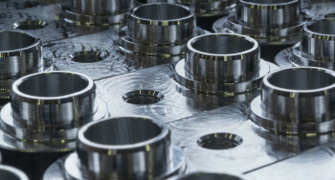
Aluminium machines quickly and cleanly due to high dimensional stability, allowing significant material removal while controlling residual stress. With carbide tooling and modern coolants, surfaces finish well. Parts can be bead blasted for a matt finish or anodised for a consistent appearance and added corrosion resistance.
Best of all, aluminium’s machinability helps reduce part cost. Material selection should reflect the properties your part needs, so what else does aluminium offer?

2. Great Strength to Weight Ratio
Aluminium is lighter than most metals, so it is a strong choice when weight savings matter. While pure aluminium has a tensile strength below 100 MPa, it can be strengthened by:
- Alloying: adding other elements to improve grain structure.
- Heat treatment: heating and cooling at a controlled rate to create the desired microstructure.
- Work hardening: deforming the metal to change its grain structure, typically during rolling, or afterwards by forging.
A temper designation indicates the material condition and strength, with H for hardened and T for thermal treatment.
It is worth noting that most aluminium alloys have a higher strength to weight ratio, or specific strength, than stainless steel 316L.
While titanium is the clear winner in the table below, when stiffness and weight saving are important, high strength aluminium alloys offer a cost-effective alternative if budgets are constrained.
| Allloy | Average Ultimate tensile strength (UTS) MPa | Density g / m³ | Specific strength kN.m / kg | |
|---|---|---|---|---|
| Titanium | Grade 5 | 3.7164 | TiGAI4V | 930 | 4.43 | 210 |
| Aluminium | 7075-7651 | 3.4365 | AlZn5.5MgCu | 490 | 2.81 | 170 |
| Aluminium | 2024-351 | 3.1355 | AlCu4Mg1 | 430 | 2.79 | 150 |
| Aluminium | 6082-7651 | 3.2315 | A|Si1MeMn | 310 | 2.68 | 120 |
| Aluminium | 5083-H111 | 3.3547 | AIMg4.5MnO.7 | 300 | 2.66 | 110 |
| Stainless Steel | 316/316L | 1.4404 | X2CrNiMo17-12-2 | 590 | 7.89 | 70 |
3. Wide Choice of Alloys and Material Properties
Aluminium is an excellent base material with many alloy grades available, each offering specific properties and uses to suit engineering requirements.
Aluminium alloys are grouped into nine series, each identified by a thousand number, for example the 6000 series. Each series is further subdivided by a grade number. In general, grades with closer numbers are more similar, for example 5082 and 5083 are nearly identical.
Here are some of the more popular grades:
- 2024: Aerospace grade with high fatigue strength. Trades ultimate tensile strength for greater ductility and toughness through copper alloying.
- 5083: Marine grade with good corrosion resistance due to higher magnesium content.
- 6082: General purpose and aerospace grade with a balanced mix of strength, ductility and corrosion resistance. Alloyed with magnesium and silicon, closely equivalent to 6061.
- 7075: High strength aerospace grade with good performance under high static loads. Heat treatable and contains zinc with magnesium and chromium.
4. High Corrosion Resistance
While corrosion resistance varies by grade, aluminium is an excellent choice when this property is required. The metal and its alloys have a strong affinity for oxygen. Highly reactive metals such as magnesium oxidise readily, while less reactive metals form loose oxide layers such as rust on iron and steel.
In contrast, aluminium forms a dense, passivating layer of aluminium oxide that seals the surface and prevents further oxidation and erosion. This layer is self repairing if scratched, so parts may not need paint or additional surface treatments, reducing manufacturing and service costs. Natural corrosion resistance can also be enhanced by anodising.
5. High Conductivity
While copper is often the go-to material for conductivity, aluminium is widely used in electrical components because it is lighter and more cost effective. It is used for busbars, battery cables and connectors, particularly in automotive and EV applications.
Its good thermal conductivity also makes it suitable for heat sinks and heat dissipation.
6. Recyclable
Sustainability is a priority in engineering. An estimated 75% of all aluminium ever produced is still in use. Recycling aluminium uses far less energy than primary production, and with impurities controlled it can be recycled repeatedly.

We have already noted that aluminium machines to a high quality finish and is naturally corrosion resistant, but for added aesthetics it can be anodised in a range of colours.
Anodising is a surface finishing process that increases wear and corrosion resistance and makes adding colour straightforward. At Protolabs we offer decorative anodising (type II) and type III anodising with a 50 µm layer for extra protection.
Anodising increases the thickness of the passivating oxide layer using acids in an electrolytic bath. Aluminium oxide is a hard ceramic, so the coating is highly wear resistant.
Material selection for CNC machined parts is critical and should align with the properties your design requires. Aluminium is often a strong choice for the reasons above, but many metal and plastic alternatives are available. To help engineers choose, we provide a pocket sized CNC materials selector as a quick reference guide.
When you upload a CAD model to our website, our quoting tool evaluates what can be machined within our capabilities and flags any risks. The findings are shown clearly in the quote, giving you the option to adjust the design and request an updated quote. If you are unsure, contact our applications engineers on +44 (0) 1952 683047 or [email protected].
Get a Quote
Ready to spec aluminium for your part? Upload your part design to receive an instant quote with finishing options tailored to your needs.


