
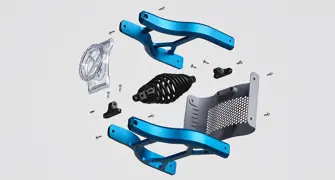
PLA 3D Printing Service
PLA is a cost-efficient, high-detail thermoplastic ideal for rapid prototyping and design validation.

What is PLA?
PLA (Polylactic Acid) is available through our 3D printing service. Commonly used as a low-cost prototyping material, it offers high stiffness and excellent surface detail, making it ideal for visual models and early-stage design concepts with fine feature resolution. As a biodegradable thermoplastic, PLA is also an economical prototyping option. Compared to ABS, PLA produces finer details but is more brittle, has lower heat resistance, and is not suited for high-temperature or demanding functional applications.
We offer the following material for PLA 3D printing:
| Material | Description |
|---|---|
| Standard PLA | Cost-effective thermoplastic offering high stiffness and excellent detail resolution. Best suited for non-functional prototypes and visual models |
PLA Material Properties for 3D Printing
| Material | Process | Tensile Strength | Tensile Modulus | Learn More |
|---|---|---|---|---|
| Standard PLA | FDM | 45-69 MPa | 3.0-3.5 GPa | Data sheet |

Applications for 3D Printing PLA Plastics
- Concept models and visual prototypes
- Design validation and early-stage testing
- Low-load components
- Educational and presentation models
- Rapid iteration parts
FAQs
What is PLA best used for in 3D printing?
expand_less expand_morePLA is best suited for concept models, visual prototypes, design validation, presentation models, and other applications where cost and detail are more important than high mechanical or thermal performance.
Is PLA suitable for functional prototypes?
expand_less expand_morePLA can be used for low-load prototypes, basic fit checks, and design validation. However, its brittleness and relatively low heat resistance make it less suitable for demanding functional applications.
What are the advantages of PLA for 3D printing?
expand_less expand_morePLA is a cost-effective material that offers high stiffness, good detail resolution, and reliable printability. These properties make it particularly useful for rapid prototyping, visual models, and early-stage design iterations.
What are the limitations of PLA 3D printing?
expand_less expand_morePLA is more brittle and has lower heat resistance than some other thermoplastics. It is therefore not recommended for high-temperature environments, high-impact applications, or parts requiring demanding mechanical performance.
What is the difference between PLA and ABS for 3D printing?
expand_less expand_morePLA is well suited to detailed, cost-effective prototypes, while ABS is often selected when greater durability and heat resistance are required. PLA can produce fine details, but it is generally more brittle and less heat resistant than ABS.