
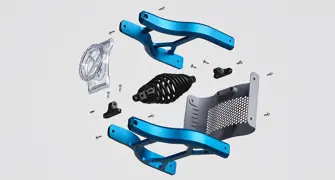
FDM 3D Printing
Fused Deposition Modelling (FDM) delivers high-quality prototypes and end-use parts in a wide range of materials with fast quoting.

What is FDM 3D Printing?
Fused deposition modelling (FDM) is a versatile 3D printing technology that builds parts layer by layer by extruding heated thermoplastic material through a nozzle. FDM 3D printing is a cost-effective option for producing functional prototypes, manufacturing aids and low-volume end-use parts.
Choose from a range of thermoplastic materials, including PLA, ABS, TPU, PETG and PEI, to meet different mechanical, thermal and performance requirements across a wide range of applications.
Benefits of FDM
- Fast turnaround for prototypes and parts
- Versatile material options, including heat- and chemical-resistant, flame-retardant, biocompatible, and high-strength materials.
- Cost-effective manufacturing for custom parts
Common Applications for FDM 3D Printing
- Aerospace: Lightweight components, enclosures, housings, and antenna covers
- Automotive: Assembly tools and prototype parts
- Consumer Electronics: Custom enclosures and housings
- Medical: Custom prosthetics and anatomical models
FDM Design Guidelines and Capabilities
Our guidelines for FDM include important design considerations to help improve part precision and reduce overall production time.
| Prototyping FDM | Industrial FDM | |
|---|---|---|
| Max Part Size | Up to 500 mm x 500 mm x 500 mm | Up to 406 mm x 355 mm x 406 mm |
| Dimensional Accuracy | 0.5 mm | ±0.3 mm |
| Unsupported/Supported Walls | Minimum 0.8 mm | Minimum 0.8 mm |
| Minimum Feature Size | 2.0 mm | 2.0 mm |
| Minimum Hole Diameter | 2.0 mm | 2.0 mm |
| Layer Height Options | 100-300 μm | 100-300 μm |
| Infill Options | Light to solid to suit strength requirements | Light to solid to suit strength requirements |
Note: Low resolution: 300-330 μm; Normal resolution: 200-254 μm; High resolution: 100 μm
FDM Material Options
| Protolabs' FDM materials for prototyping are typically selected for their ease of use, speed, and cost-effectiveness, which enable rapid design iterations and validation. Production materials are selected for their durability, mechanical performance, and long-term reliability, which ensures that they meet the requirements of end-use applications. |
FDM Materials for Prototyping:
Industrial FDM Materials:
PLA (Polylactic Acid)
expand_less expand_moreOffering an excellent surface finish and easy printability, PLA is a biodegradable material ideal for visual models and consumer products
PETG (Polyethylene Terephthalate Glycol)
expand_less expand_moreOffers a good combination of strength and flexibility, making it food-safe and suitable for mechanical parts
ASA (Acrylonitrile Styrene Acrylate)
expand_less expand_moreProvides UV resistance and durability for outdoor applications
ABS (Acrylonitrile Butadiene Styrene)
expand_less expand_moreOffers excellent impact resistance and strength, making it well suited to durable prototypes and functional parts
TPU (Thermoplastic Polyurethane)
expand_less expand_moreHighly flexible and abrasion-resistant, ideal for creating rubber-like components
Nylon (Markforged Onyx)
expand_less expand_moreOffers superior tensile strength and toughness, ideal for functional prototypes and production parts requiring durability and wear resistance
ULTEM (Stratasys)
expand_less expand_moreULTEM 9085 and ULTEM 1010: Offer high thermal and chemical resistance, making them well suited to demanding aerospace and automotive applications
ASA (Stratasys)
expand_less expand_moreCombines good mechanical properties with UV stability, making it well suited to robust outdoor and automotive components
ABS (Stratasys)
expand_less expand_moreABS M30 and ABSplus: Provides enhanced strength and stability, suitable for end-use parts needing reliable performance under stress
How Does FDM 3D Printing Work?
Fused deposition modelling (FDM) creates parts by heating and extruding thermoplastic filaments layer by layer, resulting in solid objects with practical functionality.
Unlike resin-based technologies such as stereolithography (SLA), which use liquid photopolymers cured by a UV laser to achieve fine details and smooth finishes, FDM offers the advantages of lower costs and faster production times.
Additionally, although powder-based methods such as selective laser sintering (SLS) fuse material powders into complex shapes without the need for support structures, FDM remains a versatile and economical option for producing durable parts, especially when surface finish is not the primary concern. This makes FDM ideal for functional prototypes and low-volume manufacturing across a range of industries.
FAQs About FDM 3D Printing
What is FDM 3D printing best used for?
expand_less expand_moreFDM 3D printing is well suited to functional prototypes, concept models, manufacturing aids, jigs and fixtures, and low-volume end-use parts. Its range of thermoplastic materials makes it a versatile option for applications where functionality, durability and cost-effectiveness are important.
What materials can be used for FDM 3D printing?
expand_less expand_moreFDM can use a wide range of thermoplastic materials with different mechanical, thermal and performance properties. Available materials include PLA, ABS, ASA, PETG, TPU, nylon and high-performance thermoplastics such as ULTEM, depending on the application and FDM process selected.
Is FDM suitable for functional prototypes?
expand_less expand_moreYes. FDM is commonly used to manufacture functional prototypes that can be used for fit, form and functional testing. Material selection is important, as different thermoplastics offer different levels of strength, flexibility, heat resistance and chemical resistance.
What is the difference between FDM and SLA 3D printing?
expand_less expand_moreFDM builds parts by extruding thermoplastic material layer by layer, while stereolithography (SLA) uses a light source to cure liquid photopolymer resin. FDM is often selected for functional parts and applications requiring thermoplastic materials, while SLA can be better suited to parts requiring fine details and smooth surface finishes.
What is the difference between FDM and SLS 3D printing?
expand_less expand_moreFDM deposits melted thermoplastic material through a nozzle, whereas selective laser sintering (SLS) uses a laser to fuse powdered polymer material. FDM parts may require support structures for certain geometries, while the surrounding powder in SLS supports the part during printing, allowing complex geometries to be produced without dedicated support structures.
Does FDM 3D printing require support structures?
expand_less expand_moreSome FDM parts require support structures for features such as steep overhangs, bridges and complex geometries. Designing with the FDM process in mind can help minimise the amount of support material required and reduce post-processing.
How accurate is FDM 3D printing?
expand_less expand_moreFDM dimensional accuracy depends on factors including the machine, material, part geometry and build orientation. For specific tolerances and minimum feature sizes, refer to our FDM design guidelines and capabilities.
How can I reduce the cost of FDM 3D printing?
expand_less expand_moreFDM costs can often be reduced by optimising part geometry, selecting an appropriate material and infill, and minimising unnecessary support structures. Designing specifically for the FDM process can also help reduce material use and production time.


