


PolyJet & 3D Printed Silicone 60-65%
Get 3D-Printed elastomeric parts within days. Request an online quote today.
shield_locked All Uploads are Secure and Confidential
Certifications ISO 9001:2015 | ISO 14001:2015 | ISO 13485 (Protolabs Network)

What is PolyJet?
PolyJet is an industrial 3D printing process that builds multi-material prototypes with flexible features and complex parts with intricate geometries in as fast as 1 day. A range of hardnesses (durometers) are available, which work well for components with elastomeric features like gaskets, seals, and housings.
Common applications for PolyJet 3D printing:
- prototyping designs for overmoulding or silicone rubber parts
- combining two colours or durometers into a single part
- simulating elastomers or flexible parts

PolyJet Material Options
PolyJet provides the ability to choose a desired hardness or combine material properties into a single build, which makes it ideal for prototyping overmoulding parts. Shore A hardnesses of 30A, 40A, 50A, 60A, 70A, 85A, 95A, and rigid are available in these colours:
- Digital Clear/Translucent
- Digital Black
- Digital White (please note white colour gradually becomes more translucent the lower the Shore A hardness)
- Digital Overmould
- 3D Printed Silicone (60-65%)
Compare PolyJet Material Properties
| Material | Tensile Tear Strength | Tensile Strength | Elongation | More Details |
|---|---|---|---|---|
| 30A | 5-7 kg/cm | 2.4-3.1 MPa | 220-270% | Data Sheet |
| 40A | 6-8 kg/cm | 3-4 MPa | 190-210% | |
| 50A | 7-9 kg/cm | 3-4 MPa | 170-219% | |
| 60A | 7-10 kg/cm | 3.5-4.5 MPa | 150-170% | |
| 70A | 12-14 kg/cm | 4-6 MPa | 120-140% | |
| 85A | 22-26 kg/cm | 6-10 MPa | 70-90% | |
| 95A | 26-30 kg/cm | 10-14 MPa | 50-70% | |
| Rigid | - | 50-65 MPa | 10-25% | |
| 3D Printed Silicone 35A | 3.1 kg/cm | 0.5-0.8 MPa | 160% | 3Dp Silicone Data Sheet En |
| 3D Printed Silicone 65A | 9kg/cm | 2.0-2.5 MPa | 160% |
About PolyJet
What is PolyJet?
expand_less expand_morePolyjet is a 3D Printing process that provides excellent accuracy as well as the ability to strategically alter material properties in a way not previously possible. It also allows for different colours and hardness level in a single layer, that is just a quarter of the thickness of a sheet of printer paper!
Polyjet uses a jetting process. Small droplets of liquid photopolymer, called voxels, are sprayed from multiple jets onto a build platform and cured in layers that form elastomeric parts.
PolyJet is an industrial 3D printing process that builds multi-material prototypes with flexible features and complex parts with intricate geometries in as fast as 1 day. A range of hardness's (durometers) are available, which work well for components with elastomeric features like gaskets, seals, and housings.
PolyJet design guidelines will help you understand capabilities and limitations.
Why Choose PolyJet for your 3D Printing Project?
expand_less expand_morePolyJet technology offers outstanding detail, surface smoothness and precision, creating detailed prototypes that convey final-product aesthetics. You can simulate elastomers and flexible parts, create prototyping designs for overmoulding and liquid silicone rubber moulding and manufacture really complex part geometries. We also offer a number of secondary services such as painting, post machining and measurement and inspection, to further enhance the finish of your 3D-printed project design.
PolyJet material data sheets can be found in our Material Comparison Guide
How Does PolyJet Work?
expand_less expand_more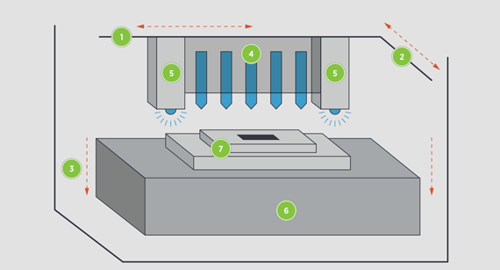
The components of a PolyJet 3D printer include: x axis (1), y axis (2), z axis (3), photopolymer jets (4), uv lamp (5), build tray (6), part with flexible and rigid materials (7)
The PolyJet process begins by spraying small droplets of liquid photopolymers in layers that are instantly UV cured. Voxels (three-dimensional pixels) are strategically placed during the build, which allow for the combination of both flexible and rigid photopolymers know as digital materials. Each voxel has a vertical thickness equal to the layer thickness of 30 microns. The fine layers of digital materials accumulate on the build platform to create accurate 3D-printed parts.
Each PolyJet part is completely coated in support material during the build, which ultimately is removed by hand using a pressurised water stream and a chemical solution bath. No post-curing is required after the manufacturing process.
What are the Benefits of PolyJet?
expand_less expand_more- Good for producing complex parts
- Can support complex geometries with multiple materials and colours
- High accuracy
PolyJet Design Considerations
expand_less expand_morePolyJet Design Considerations
- Unsupported walls and features can be as small as 0.8 mm, but if they are to be used in a functional fashion or for load-bearing, they should be at least 1.0 mm across. Height of these features depends partly on the material and part geometry. Very tall freestanding walls and bosses should be avoided as they can be damaged when support is removed.
- It is difficult to remove support materials on holes, slots, and channels that are much smaller than 0.75 mm across. In reality, features this narrow may not form properly.
- Weep holes and land-locked shapes are ok if holes are large enough to allow for rinsing of support material. However, unless there is good reason, it is suggested to leave them closed. It's likely you won't notice the trapped support material.
- Prototypes for overmoulded parts or those with integral gasket material, should be designed with zero clearance of up to 0.05 mm interference fit. Leaving any kind of gap can result in components coming apart in your hands.
- Digital Photopolymers have soft touch and flexible features, they also have improved grip, impact resistance and two-toned colouring aesthetics.
- 3D Printed silicone has high temperature and weather resistance. Allows for the possibility of very-thin walls and elastic models. It also comes in different hardnesses and thin parts can be easily bent thanks to their good elasticity.
Polyjet: What is it used for?
Polyjet is an advanced 3D printing process that allows us to simulate elastomers and flexible parts and create prototyping designs for overmoulding and liquid silicone rubber moulding.
We can combine two-tone colours and multiple materials into a single part and manufacture the most complex part geometries.
Find out more about this exciting technology in our new video
Get a QuoteResources


