

What is POM?
Polyoxymethylene (POM), also called acetal or polyacetal, is a stiff, low-friction engineering plastic that maintains dimensional stability over time. It resists wear, machines cleanly, and is often used for gears, bushings, bearings, and other parts that require reliable, repeatable performance.
POM comes in two main types:
- POM-H (homopolymer acetal): Often referred to as Delrin, this grade offers higher stiffness, tensile strength, and fatigue resistance. Learn more about how Delrin can replace metal in some applications.
- POM-C (copolymer acetal): Slightly lower in strength, but better at handling chemicals and processing heat. It also has no centerline porosity, which can make it a better choice for thicker cross-sections.
In practice, engineers often use acetal to mean POM-C and Delrin to mean POM-H, even though both are technically acetals.
POM Glossary
- POM (polyoxymethylene): The polymer family
- Acetal: A common generic name for POM materials
- POM-H: Homopolymer acetal
- POM-C: Copolymer acetal
- Delrin: A brand name for POM-H

Protolabs POM Capabilities
Protolabs offers POM for both CNC machining and injection moulding, with the following capabilities:
POM for Injection Moulding
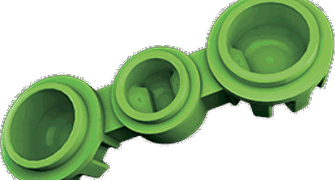
Injection moulding is ideal for producing POM parts at scale, particularly when you need high repeatability and consistent geometry. Protolabs supports both injection moulded acetal and injection moulded Delrin, depending on the specific homopolymer or copolymer grade required.
| Capability | Details |
|---|---|
| Best for | High-volume end-use parts, complex geometries, and repeatable production. |
| Tolerance | Typically ~0.003–0.005 in./in. depending on geometry, grade, and shrink behavior. |
| Shrinkage | Typically around 1.5–2.5% depending on grade and flow direction. Uniform wall thickness and proper draft help maintain dimensional accuracy. |
| Wall thickness | Minimum 0.040 in. (1.0 mm) recommended to help reduce warping or sink. |
| Surface finish | Generally smooth, but final finish depends on mold quality and part geometry. |
| Data sheets | Celcon M90 (Acetal Copolymer), Delrin 500P (Acetal Homopolymer), Delrin 520 MP, Delrin 577, RTP 800 GB 10 (10% Glass Bead), RTP 800 GB 20 (20% Glass Bead) |
POM for CNC Machining
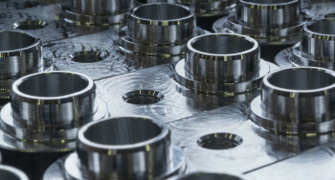
CNC machining is a strong choice for quick-turn prototypes and low-volume POM parts, with both acetal and Delrin available.
| Capability | Details |
|---|---|
| Best for | Prototypes, low-volume production, and parts requiring close tolerances or larger cross-sections. |
| Tolerance | Aligns with ISO 2768-medium unless otherwise specified. |
| Colour options | Natural and black. Natural acetal copolymer is FDA, USDA, NSF, and 3A Sanitary compliant, while the black copolymer grade is also listed as FDA compliant. |
| Surface finish | Typically milled and matte, depending on toolpath and speed. |
| Data sheets | Tecaform (Acetal Copolymer), Tecaform SD (ESD Acetal Copolymer), Delrin 150 (Acetal Homopolymer), Delrin 570 (20% Glass Filled) |
Manufacturing With POM
POM is a versatile material, but it behaves a little differently depending on how it’s manufactured. From shrinkage in injection moulding to fixturing considerations in CNC machining, understanding these basics upfront helps ensure you get the performance you want.
CNC Machining With POM
CNC machining is a great fit for quick-turn prototypes and low-volume POM parts where tight tolerances and clean machining are top priorities. It is a common choice for gears, bushings, and wear strips because it machines cleanly and holds its shape well.
Design Guidelines
- Choose POM-C for thicker parts, where centerline porosity can be a concern in homopolymer stock
- Choose POM-H when stiffness, strength, and fatigue resistance matter most
- Support thin features during machining to prevent deflection, especially on longer parts
- POM machines cleanly, but sharp tools help prevent heat buildup and preserve surface finish
Injection Moulding With POM
When you move from prototypes to production, injection molding is often the most efficient way to make POM parts. It delivers consistent geometry and repeatability, but good part design is important to manage shrinkage and avoid cosmetic defects.
Design Guidelines
- Maintain uniform wall thickness to manage POM’s relatively high shrinkage
- Use draft angles (≥1°) to help parts release cleanly
- Avoid thick sections, which can cause sink due to shrinkage
- Add fillets to improve flow and reduce stress concentrations

Advantages and Disadvantages of POM
POM has clear strengths and a few tradeoffs. Here’s where it tends to perform well, and where another material may be a better fit.
Advantages
- Rigid and dimensionally stable: POM holds tight tolerances and keeps its shape over time, which is why it’s so common in precision parts.
- Low friction and good wear resistance: It performs well in sliding applications like gears, bearings, and bushings, often without requiring additional lubrication.
- Resistant to moisture: Standard unfilled grades absorb very little water (around 0.20–0.25% over 24 hours), helping parts maintain dimensional stability.
- Handles repeated movement well: Homopolymer grades in particular offer excellent fatigue resistance for snap fits, springs, and moving components.
- Machines cleanly: POM is one of the easiest engineering plastics to machine as it cuts cleanly, holds tight tolerances, and produces smooth surfaces.
Disadvantages
- Limited chemical resistance in harsh environments: While it handles fuels and many solvents well, POM is not ideal for strong acids or oxidising chemicals.
- Not ideal for prolonged UV exposure: Standard grades can degrade outdoors without stabilisation. See our guide to UV-resistant plastics for better material options.
- Can shrink during moulding: Injection-moulded POM shrinks more than some plastics, so part design and flow direction need to be factored in.
- Moderate temperature limits: It performs well in many engineering applications but cannot handle sustained high temperatures like materials such as PEEK.
- Hard to bond with adhesives: Mechanical fastening, press fits, or welding methods are often more reliable than adhesive bonding.
POM Compared to Similar Materials
POM overlaps with several other engineering plastics, but there are key differences when it comes to wear, moisture, heat, and cost.
| Material | Stiffness | Wear Resistance | Moisture Resistance | Max Service Temp. | Common Uses | Pros | Cons |
|---|---|---|---|---|---|---|---|
| POM (Acetal / Delrin) | High | Excellent | Excellent | ~185–195°F | Gears, bushings, bearings | Rigid, low friction, dimensionally stable | Acid‑sensitive, hard to bond |
| Nylon (PA 6/66) | Moderate | Good | Poor | ~200–220°F | Gears, rollers, structural parts | Strong, heat‑resistant, fatigue‑tolerant | Absorbs moisture |
| PEEK | Very high | Excellent | Excellent | ~480–500°F | Aerospace structures, medical devices | Extreme heat & chemical resistance | High cost |
| PTFE | Low | Good | Excellent | ~500°F | Seals, liners, sliding parts | Ultra‑low friction, chemical resistance | Low stiffness, hard to machine |
| HDPE | Low–Moderate | Moderate | Excellent | ~175–180°F | Tanks, housings, food equipment | Lightweight, low cost, chemical resistant | Flexible, less precise |
| PP (Polypropylene) | Moderate | Moderate | Excellent | ~210°F | Chemical tanks, living hinges | Chemically resistant, fatigue tolerant | Lower stiffness than POM |
All values are typical and intended for comparison purposes only. Refer to our materials page and individual datasheets for grade-specific data before making material selection decisions.
Material Highlights
- Nylon (PA): Better heat resistance than POM but absorbs moisture, which can affect dimensional stability
- PEEK: Handles extreme heat and chemicals much better than POM, but at a higher material and machining cost
- PTFE: Offers lower friction than POM, but lacks its stiffness and structural strength
- HDPE: A lower-cost alternative with excellent chemical resistance, but it is far less rigid and dimensionally stable
- PP: Good for chemically resistant parts and living hinges, but not ideal for precision wear components
Applications
POM is used across industries for parts that need precision, low friction, and reliable mechanical performance:
- Medical: Drug delivery components, inhaler parts, and handles
- Aerospace: Gears, bushings, standoffs, and lightweight components
- Consumer electronics: Snap-fit housings, keyboard mechanisms, printer parts, and actuators
- Automotive: Door lock mechanisms, regulator parts, gears, and fuel-system components
- Industrial equipment: Conveyor guides, valve seats, bushings, wear strips, and pump components
Get a Quote
Ready to machine or mould POM parts? Upload your CAD file for an instant quote and design feedback.


