

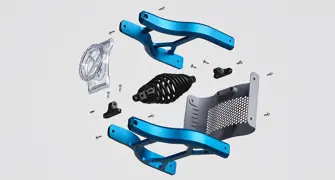

Multi Jet Fusion (MJF)
Multi Jet Fusion (MJF) 3D printing can build quality nylon parts suitable for rapid prototyping and production.
shield_locked All Uploads are Secure and Confidential
Certifications ISO 9001:2015 | ISO 14001:2015 | ISO 13485 (Protolabs Network)
Jump to Section
→ Design Guidelines & Capabilities
→ MJF Materials
→ Comparison Material Properties
→ What is MJF?
→ Why MJF?
→ How MJF Works
Multi Jet Fusion is an industrial 3D printing process that produces functional nylon prototypes and end-use production parts in as fast as 1 day. Final parts exhibit quality surface finishes, fine feature resolution, and more consistent mechanical properties when compared to processes like selective laser sintering.
Common applications for Multi Jet Fusion are:
- parts requiring consistent isotropic mechanical properties
- functional prototypes and end-use parts
- complex and organic geometries with fine features

MJF Material Options
PA 12 Black
expand_less expand_morePA 12 Black is a high tensile strength nylon. Final parts are dyed black, and they exhibit quality surface finishes and slightly more isotropic mechanical properties when compared to SLS. When more detail is required, PA 12 can achieve smaller minimum feature resolution 0.5mm as compared to SLS materials 0.75mm PA 12 Smooth Light Grey is the best material option for designs that incorporate living hinges.
Primary Benefits
- Near isotropic mechanical properties
- Economical material choice
PA 12 Glass Beads Black
expand_less expand_morePA12-Glass Beads Black is a 40% glass bead polyamide with excellent stiffness and dimensional stability. The material possesses higher thermal resistance than unfilled polyamides and exhibits excellent long-term wear resistance. Due to the glass additive, it has decreased impact and tensile strengths compared to other nylons.
Primary Benefits
- Stiffness and dimensional stability
- Long-term wear resistance
- High-temperature resistance
PA 12 Flame Retardant Grey
expand_less expand_morePA 12 Flame Retardant is a halogen-free, UL94-certified material that can be used across a wide range of industries. It opens up new possibilities by combining the design freedom of 3D printing with flame-retardant properties.
PA 11 Black
expand_less expand_morePA 11 Black provides excellent ductility and temperature resistance without sacrificing tensile strength. It offers one of the highest elongation break thresholds in the nylon family.
Primary Benefits
- Isotropic Mechanical Properties
- Enhanced Elongation at Break
- Water and airtight without any further treatment
UltrasintTM TPU-01 - 88A Black
expand_less expand_moreThis thermoplastic polyurethane (TPU) combines rubber-like elasticity and elongation with good abrasion and impact resistance. Ideal for automotive components due to its high chemical resistance to oil and grease. Also possessing high UV resistance. Showing high accuracy and detail resolution, supporting optimisation of lattice structure designs.
Primary Benefits
- Flexibility
- Tear and Abrasion Resistance
- High Durability
Compare MJF Material Properties
| Material | Colour | Tensile Strength | Tensile Modulus | Elongation |
|---|---|---|---|---|
| PA 12 | Black | 49 MPa ± 4 MPa | 1900 MPa ± 200 MPa | 12% ± 4% |
| PA 12-Glass Beads | Black | 30 MPa ± 5 MPa | 2500 MPa ± 400 MPa | 10 ± 5% |
| PA 12 Flame Retardant Grey | Grey | 46 MPa | 2540 MPa | 4% |
| PA 11 | Black | 52 MPa | 1800 MPa | 35% |
| UltrasintTM TPU01 - 88A | Black | 9MPa ± 2MPa | 75 MPa | >220% |
These figures are approximate and dependent on a number of factors, including but not limited to, machine and process parameters. The information provided is therefore not binding and not deemed to be certified. When performance is critical, also consider independent lab testing of additive materials or final parts.

3D Printing Surface Finish Guide
Our 3D Printing surface finish guide provides you with a quick overview of our finishing options and what you can expect when your 3D-printed parts arrive.
3DP Surface Finish GuideAbout Multi Jet Fusion
What is Multi Jet Fusion?
expand_less expand_moreMulti Jet Fusion is an industrial 3D printing process that produces functional nylon prototypes and end-use production parts in as fast as 1 day. Final parts exhibit quality surface finishes, fine feature resolution, and more consistent mechanical properties when compared to processes like selective laser sintering.
Multi Jet Fusion design guidelines will help you understand capabilities and limitations.
Why Choose Multi Jet Fusion for your 3D Printing Project?
expand_less expand_moreMJF offers engineering grade materials with great overall properties. Additionally, MJF offers enhanced surface finish, finer features, more consistent mechanical properties, and faster build times. We also offer a number of secondary services such as painting, post machining and measurement and inspection, to further enhance the finish of your 3D-printed project design.
Multi Jet Fusion material data sheets can be found in our Material Comparison Guide
How does Multi Jet Fusion Work?
expand_less expand_more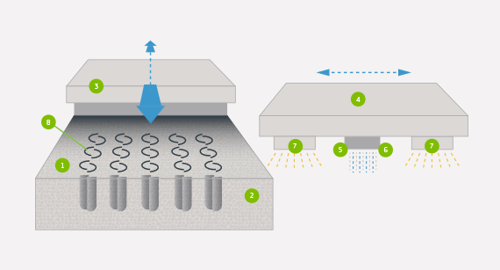
The components of a Multi Jet Fusion 3D printer include: nylon layer (1), powder bed (2), material recoating unit (3), print carriage (4), inkjet array (5), fusing and detailing agents (6), thermal energy (7), part (8).
Multi Jet Fusion uses an inkjet array to selectively apply fusing and detailing agents across a bed of nylon powder, which are then fused by heating elements into a solid layer. After each layer, powder is distributed on top of the bed and the process repeats until the part is complete.
When the build finishes, the entire powder bed with the encapsulated parts is moved to a processing station where a majority of the loose powder is removed by an integrated vacuum. Parts are then bead blasted to remove any of the remaining residual powder before ultimately reaching the finishing department where they are dyed black to improve cosmetic appearance.
Benefits of Multi Jet Fusion
expand_less expand_more- Fine minimum feature size
- Accelerated build time
- More consistent isotropic mechanical properties in the Z build direction when compart to other additive processes
- Improved surface roughness
Multi Jet Fusion Design Considerations
expand_less expand_more- Thin-walled or large, flat surfaces should be reinforced with ribs or gussets, and holes surrounded with raised bosses wherever possible.
- Raised text and cosmetic part features smaller than 0.5mm might not survive secondary post-processing. Check the design for manufacturability analysis that accompanies your part quote for details.
- Wall thicknesses from 2.5 - 4.0 mm are ideal.
- If your geometry has a thick area (> 4 mm), as a rule, hollowing out the part to a wall thickness of 2 to 4 mm will be required, to avoid sink marks or even a machine crash. Protolabs will modify the CAD file. Un-sintered powder will remain within the hollowed-out part and cannot be removed.
- MJF does a great job with assemblies, living hinges, snap fits, and pin hinges.
- As with any 3D printing process, MJF produces some stair-stepping on oblique angles. Cosmetic surfaces should be clearly identified on the part drawing or digitally in the product manufacturing information (PMI), so Protolabs can attempt to orient the parts in the build chamber accordingly.
- PA 12 Smooth Light Grey is water and airproof without further treatment. It also has near isotropic mechanical properties.
- PA 11 Available as Smooth Grey and Vapour Smooth Black.
- Ultrasint™ TPU01 - 88A Pure Grey and Vapour Smooth Black is flexible, durable, with tear and abrasion resistance. It also has high chemical resistance, impact resistance and high UV resistance. It is a great candidate for the automotive industry and sporting products.
Multi Jet Fusion: What is it used for?
For fast, quality results, Multi Jet Fusion (MJF) is unparalleled as a 3D printing process. It’s able to produce functional nylon prototypes and end-use production parts in a single day, featuring quality surface finishes and fine feature resolution. It also offers more consistent mechanical properties than similar processes like selective laser sintering.
Using an inkjet array to repeatedly apply fusing agents across a bed of nylon powder, followed by fusion into a solid layer via heating elements, MJF is able to offer complex and detailed features. Protolabs offers a commercial-grade unfilled Nylon 12 material to create durable parts. Multi Jet Fusion offers a fast and advanced way to create parts on demand. Discover more with this short video.
Get a QuoteResources


