
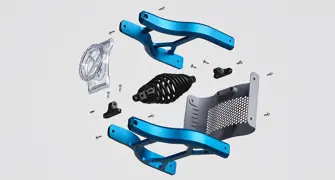

Why Rust Prevention Matters in Production Parts
Corrosion is one of the most common causes of premature part failure. For engineers working with steel, iron, and other ferrous metals, selecting the right finish is critical to maintaining dimensional stability, structural integrity, and long-term performance.
Rust forms when iron reacts with oxygen and moisture. In industrial and outdoor environments, exposure to salt, humidity, chemicals, and temperature variation accelerates this process. Surface finishes act as a barrier or modify the metal surface to reduce or prevent oxidation.
Choosing the right finish depends on several application-specific factors. The base material determines which treatments are compatible and how the surface will respond to coating or plating processes. Environmental exposure, such as humidity, salt spray, chemicals, or temperature fluctuation, directly affects the level of corrosion resistance required. Mechanical wear requirements matter when parts experience friction, abrasion, or repeated handling, as some finishes provide added hardness while others are primarily protective. Electrical conductivity needs can also influence selection, since certain coatings insulate the surface while others maintain conductive properties. Finally, cost and production volume play a practical role, as some finishes are more economical for high-volume production while others are better suited to low-volume or precision applications.
Protolabs offers a range of finishing options across production manufacturing applications to support corrosion-resistant designs.

Common Finishes for Preventing Rust
Zinc Plating
Zinc plating provides sacrificial corrosion protection for steel components. The zinc layer corrodes before the underlying steel, extending service life.
Best for:
- Fasteners
- Brackets
- Structural components in moderate environments
Zinc plating is cost-effective and widely used in industrial equipment and automotive applications. It may require additional sealing for high-humidity or salt-exposed environments.
Explore zinc plating and other finishing options for CNC machined parts.
Electroless Nickel Plating
Electroless nickel plating deposits a uniform nickel-phosphorus coating without electrical current. It improves corrosion resistance while maintaining tight tolerances.
Advantages:
- Uniform coverage on complex geometries
- Improved hardness and wear resistance
- Better corrosion protection than standard zinc
This finish is commonly used for precision components that require both corrosion resistance and dimensional consistency.
Explore electroless nickle plating and other finishing options for CNC machined parts.
Anodizing for Aluminum
While aluminum does not rust like steel, it can corrode. Anodizing thickens the natural oxide layer, improving corrosion resistance and surface hardness.
Types include:
- Type II anodizing for general corrosion resistance
- Type III hardcoat anodizing for wear resistance
Anodized aluminum is widely used in aerospace, industrial automation, and electronics housings.
Explore aluminum anodizing finishing options.
Powder Coating
Powder coating applies a dry powder that is cured under heat to form a protective layer. It provides both corrosion resistance and aesthetic finish.
Benefits:
- Thick, durable coating
- High resistance to moisture and chemicals
- Wide color and texture options
Powder coating is commonly selected for exposed components, enclosures, and outdoor applications.
Explore powder coating and other finishes for CNC machined parts.
Black Oxide
Black oxide provides mild corrosion resistance when used with oil or sealant. It is often selected for appearance and light protection rather than long-term exposure.
Best suited for:
- Indoor components
- Tools
- Low-moisture environments
Explore black oxide finishing via Protolabs Network.
Comparing Rust-Prevention Finishes
Material selection and environmental conditions should guide the final decision.
Design Considerations for Corrosion Resistance
Corrosion resistance starts at the design stage. Engineers should consider:
- Avoiding crevices that trap moisture
- Specifying appropriate surface finishes early in the design process
- Accounting for coating thickness in tolerance stack-ups
- Evaluating galvanic corrosion when combining dissimilar metals
Surface finish selection also impacts manufacturability and cost. Early collaboration reduces rework and production delays.
Protolabs provides automated design feedback to help engineers evaluate manufacturability before production begins. Learn more about design for manufacturability.
Corrosion Resistance in Low-Volume and Production Runs
Rust prevention is not limited to high-volume orders. Replacement parts, prototypes, and bridge production runs often operate in the same demanding environments as full-scale production components.
Protolabs gives you on-demand access to corrosion-resistant parts across low-volume and bridge production, maintenance, repair and operations (MRO) manufacturing, and all stages of the product life cycle.
Specify the finishes you require directly during the quoting platform to receive accurate pricing and lead time information.

Selecting the Right Finish for Your Application
No single finish is appropriate for every application. The optimal solution balances corrosion resistance, wear performance, appearance, and cost while supporting the functional requirements of the part.
Engineers should evaluate the operating environment first, including whether the component will be exposed to moisture, salt, chemicals, or temperature variation. It is also important to consider how the selected coating may affect tolerances, surface buildup, or assembly interfaces. In some applications, maintaining electrical conductivity is critical, which may limit the choice of finish. Finally, expected service life plays a key role in determining the appropriate level of protection, as short-term use may require a different solution than components designed for long-term field exposure.
Working with a manufacturing partner that understands these trade-offs helps reduce risk during production.
|


