
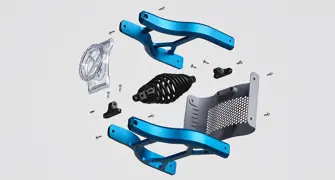

Weight is a critical factor in drone manufacturing. Reducing it can improve flight time, increase payload capacity, and enhance overall efficiency. For this reason, 3D printing is widely used in UAV development, allowing engineers to rapidly iterate designs and produce complex geometries that are difficult to achieve with traditional methods. Recent advances in Multi Jet Fusion (MJF) technology, including the HP 5620 Pro with Process Development, are expanding the possibilities for lightweight drone components. With greater control over printing parameters, it’s now easier to produce finer structures support high performance, lightweight UAV systems.
Multi Jet Fusion in Drone Manufacturing
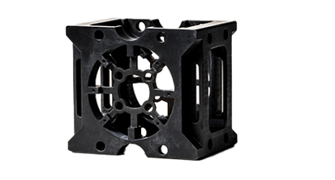
MJF is widely used for drone components because it offers high mechanical strength and durability while supporting complex geometries that are difficult to produce with traditional manufacturing methods. The process is well suited to low-volume production and functional prototyping, providing flexibility to test and refine designs quickly. It also provides a strong balance between cost, speed, and performance, making it an efficient option for UAV development.
Examples of common drone applications include:
- Mounting brackets
- Camera housings
- Sensor mounts
- Structural frames
- Cable routing components
- Wing structures
- Fuselage
- Stabilizers

New: HP 5620 Pro with Process Development
Recent advances in Multi Jet Fusion technology are expanding what 3D printing can achieve for the aerospace industry. HP 5620 Pro with Process Development gives product developers greater control over the printing process. Previously, MJF systems operated with a fixed set of process parameters that applied to all geometries, which limited certain design possibilities. The new capability allows parameters to be adjusted based on part geometry, mechanical requirements, and feature size. This flexibility enables more precise process control and makes it possible to manufacture parts that were previously difficult or impossible to print.
Protolabs operates the latest versions of HP MJF printers (5620 Pro) as part of our suite of machines. Accessible on demand, customers can quickly and cost-effectively experiment with the new technology for drone development.
Enabling Finer Structures for Lightweight Design
The adjustable process parameters in the HP 5620 Pro finetune the 3D printing process to suit specific geometries and performance requirements. This makes it possible to produce thinner walls and features with finer structures. This level of control is particularly beneficial for complex components that require weight reduction without sacrificing strength.
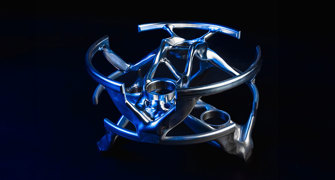
For drone applications, these capabilities can have a significant impact on overall performance. Lighter components reduce the total weight of the aircraft, which can improve structural efficiency, increase payload capacity, and extend flight time. It also helps produce complex designs, such as internal lattice structures or topology optimized geometries that would be difficult to achieve with traditional manufacturing methods. These advances open the door to a wider range of drone components designed specifically for lightweight performance.
Learn more about how Multi Jet Fusion supports lightweight, high-performance parts.

Additional Benefits of Advanced MJF
HP 5620 Pro technology also improves productivity and overall process control. Greater flexibility in parameter settings allows manufacturers to optimize printing conditions for specific geometries, which can increase efficiency and improve build reliability. This makes it easier to produce parts with demanding features while maintaining consistent results across production runs.
The added control also expands design freedom. With the ability to finetune the process for different requirements, challenging geometries and detailed features can be printed more consistently, and with more predictable outcomes.
Beyond drones, these capabilities are valuable across industries that require high-performance components with complex geometries. Robotics and automation systems can benefit from lightweight end effectors, sensor mounts, and structural components that improve motion efficiency. In automotive and industrial equipment, engineers can use the improved process control to produce optimized housings, functional assemblies, and lattice reinforced parts that balance strength, weight, and manufacturability.
Design Considerations for Lightweight Drone Parts
Several design strategies help improve performance while minimizing weight. Because this 3D printing process supports complex geometries and fine features, it allows designers to move beyond the limitations of traditional manufacturing methods and optimize parts for both strength and efficiency.
Key design considerations include:
- Thin walls and reinforcing ribs: Use thin wall sections combined with ribs to maintain strength while reducing material use and overall weight.
- Topology optimization: Apply simulation driven design tools to remove unnecessary material and concentrate strength where it is needed most.
- Part consolidation: Integrate multiple components into a single printed part to reduce assembly steps, fasteners, and additional weight.
- Lattice and internal structures: Incorporate internal lattices or other lightweight structures to maintain rigidity while significantly reducing mass.
Advances in Multi Jet Fusion process control are broadening the possibilities for creating lighter and more sophisticated drone components. With greater flexibility in printing parameters, engineers can push the limits of lightweight design while maintaining the strength and functionality required for demanding UAV applications. This evolution in additive manufacturing also helps drone developers iterate faster and bring new designs to market.
Personalized Advice for Drone Parts
Explore what’s possible with Multi Jet Fusion and start your next project with Protolabs. Upload a CAD file for instant pricing and lead times. Talk to our 3D printing experts to unlock the technology’s full capabilities for lightweight drone components.


