

What Is a Polyamide? Common Types and Manufacturing Applications

Polyamides are a family of polymers that are common in manufacturing due to their combination of strength, toughness, wear resistance, and chemical resistance. They’re used in everything from gears and bearings to automotive components, electrical connectors, and housings.
Many of the polyamides used in manufacturing are better known as nylons, including PA 6, PA 66, PA 11, and PA 12. While they share some characteristics, their mechanical properties, moisture absorption, thermal performance, and suitability for different manufacturing processes can vary significantly.

What Is a Polyamide?
A polyamide (PA) is a polymer containing repeating amide bonds within its molecular structure. Polyamides can occur naturally (proteins such as wool and silk fall within the chemical classification), but the term usually refers to synthetic engineering thermoplastics used in manufacturing.
Synthetic polyamides are valued for a balance of mechanical strength, toughness, wear resistance, and relatively low friction. Depending on the grade, they can also provide good resistance to oils, fuels, and other chemicals. These characteristics make polyamides suitable for functional components that need to withstand mechanical loads or demanding operating environments.
There isn’t one standard polyamide material. PA 6, PA 66, PA 11, and PA 12 have different molecular structures and, as a result, different performance characteristics. Polyamides can also be reinforced with glass or carbon fiber or modified with additives to achieve properties required for a particular application.
What Does PA Mean?
PA stands for polyamide, and the numbers that follow it identify the chemical structure of the polymer and how it is produced. PA 6 and PA 66, for example, are chemically distinct materials rather than different grades of the same polymer.
These differences affect practical considerations such as stiffness, heat resistance, impact strength, moisture absorption, and dimensional stability. That makes the specific PA designation more useful for material selection than the broader term “polyamide.”
Is Polyamide the Same as Nylon?
Polyamide and nylon are often used interchangeably, but they don’t mean exactly the same thing. Polyamide is the broader chemical family, while nylon is the common name for many synthetic polyamides used as engineering plastics.
For example, PA 6 is commonly called nylon 6, PA 66 is nylon 66, and PA 12 is nylon 12. In technical specifications and manufacturing material lists, you’re likely to encounter the PA designation because it identifies the particular polymer more precisely.
The distinction becomes especially useful when comparing manufacturing processes. PA 6 and PA 66 are widely available as injection molding and CNC machining materials, while PA 11 and PA 12 are commonly associated with polymer 3D printing, including selective laser sintering (SLS) and Multi Jet Fusion (MJF).
On a more granular level, an unfilled PA 66, glass-filled PA 66, and PA 12 formulated for additive manufacturing can have vastly different mechanical and thermal properties, even though all three belong to the polyamide family.
Common Types of Polyamide
The properties of polyamide vary considerably by type, so the specific PA designation matters when comparing materials. Polyamides are also available in reinforced formulations. Adding glass or carbon fiber can increase stiffness, strength, and dimensional stability, while other additives can modify characteristics such as flame resistance, friction, or electrical properties.
Moisture Absorption
Moisture absorption is an important distinction between polyamide types. PA 6 and PA 66 absorb more moisture than PA 11 and PA 12, which can affect dimensions as well as mechanical properties. The extent depends on the material, environmental conditions, and conditioning state. This is one reason PA 12 is widely used for applications where dimensional stability is important.
How Are Polyamides Used in Manufacturing?
Polyamides work well with several manufacturing technologies. Take note of technical considerations, depending on the end-use of your part.
Injection Molding with Polyamides
Plastic injection molding is commonly used to manufacture polyamide parts in higher volumes. PA 6 and PA 66 are widely available as injection molding materials, including glass-filled formulations for applications requiring additional stiffness or strength.
Because many polyamides are hygroscopic, material drying and moisture control are important processing considerations. Shrinkage, wall thickness, and fiber orientation can also influence the performance and dimensional accuracy of molded parts.
CNC Machining with Polyamides
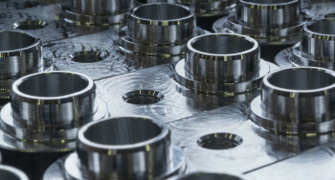
Polyamides can also be CNC machined for prototypes, lower-volume components, fixtures, and parts requiring tight tolerances or features that are difficult to achieve through molding.
Compared with metals, polyamides have lower stiffness and thermal conductivity. Account for cutting force, heat generation, workholding, and moisture-related dimensional changes when machining polyamides with precise features.
3D Printing with Polyamides
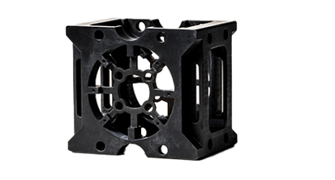
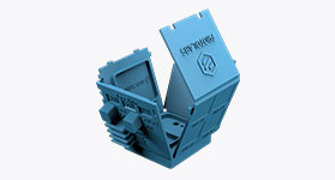
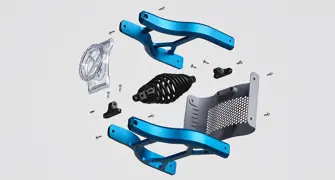
PA 11 and PA 12 are among the most widely used materials for industrial 3D printing. Powder-bed technologies such as selective laser sintering (SLS) and Multi Jet Fusion (MJF) can produce complex polyamide parts without dedicated tooling or support structures. As they’re comparatively tough and durable, these materials are suitable for functional prototypes as well as end-use production. Common applications include housings, brackets, clips, snap-fits, ducts, and other complex geometries.
Choosing a Polyamide Material
There is no single set of properties that applies to every polyamide. PA 6, PA 66, PA 11, and PA 12 differ in stiffness, strength, impact resistance, temperature performance, chemical resistance, and moisture absorption. Filled and modified grades introduce another level of variation.
The manufacturing process also narrows the material options. A PA 12 formulated for MJF, for example, is not directly interchangeable with an injection molding grade of PA 66 simply because both are polyamides. Comparing individual grades based on the requirements of the part is more useful than relying on the broader polyamide classification.
FAQ
How does moisture absorption affect polyamide parts?
expand_less expand_moreAbsorbed moisture can change the dimensions and mechanical properties of polyamide parts. The effect varies by material, with PA 6 and PA 66 generally absorbing more moisture than PA 11 and PA 12. This can make moisture behavior an important consideration for parts with tight tolerances or changing environmental conditions.
What is the difference between PA 6, PA 66, and PA 12?
expand_less expand_morePA 6 offers a balance of strength, toughness, and wear resistance, while PA 66 generally provides greater stiffness and heat resistance. PA 12 absorbs less moisture and offers good dimensional stability and chemical resistance. The materials also suit different manufacturing processes, with PA 6 and PA 66 common in injection molding and machining, and PA 12 widely used in additive manufacturing.
How do glass-filled polyamides compare with unfilled grades?
expand_less expand_moreGlass fiber reinforcement typically increases the stiffness, strength, and dimensional stability of a polyamide, but it also changes characteristics such as impact behavior and processing. Fiber orientation can influence the properties of a finished molded part, so a glass-filled grade should be evaluated as a distinct material rather than simply a stronger version of its unfilled counterpart.
|


