

FlameRetardant 3D Printing
Guidelines and applications for flame-retardant 3D printing materials
Certification + Compliance
ISO 9001:2015 | AS9100D | ITAR
The problem with many plastics is that they have a tendency to burn—or even accelerate flames—when near a fire. In some situations, it’s important to keep that in mind with your 3D-printed parts. Advanced photopolymers like Flame Retardant Black (Arkema FR512) address this issue.
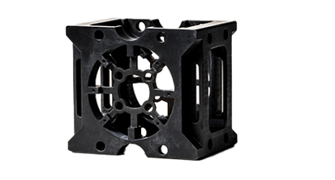
Flame retardancy is determined by Underwriters Laboratory (UL), which uses precise tests to confer its ratings. Arkema FR512 achieves a rating of UL 94 V-0 at 0.031 in. (0.79mm) and owing to being 3D-printed using Axtra3D Hybrid PhotoSynthesis (HPS) technology, it can offer you the chance to create more organic shapes than with other manufacturing methods.
Because this material retains its mechanical and thermal properties over time, it is well-suited for use throughout the entire development lifecycle—from prototyping and functional testing to end-use applications—including both production and spare parts.

Guidelines and Capabilities
Flame Retardant Black (Arkema FR512) is a resin that achieves a UL-94 rating of V-0 at 0.031 in. (0.8mm) while maintaining good accuracy when printing fine-featured parts. It is noted for:
- High strength and heat deflection temperature (HDT)
- Liquid at room temperature
- Robust printing and processing
As with any manufacturing, HPS has some guidelines you need to follow to get quality parts quickly. This chart provides those details:
Applications for 3D-Printed Flame Retardant Parts
Arkema FR512 is black, stiff, and inflexible, but is well-suited for high temperatures beyond its flammability properties (HDT is 94C). It’s often used in electronics, such as connectors, cable management, and small housings. Really, you’ll see it anywhere electricity or data transmission runs through and where there is desire to mitigate the risk of a burn starting or spreading.

3D printing this material makes sense when compared to injection molding. Many parts have geometries that are not suitable for molding or high-mix, low-volume situations. We have heard from customers that custom electrical connectors take several weeks to months to arrive in quantity, but 3D-printed parts allow them to continue with assembly until connectors arrive in higher quantities.


