

How Small Batch Production Helps you Scale on Demand

The moment when a tested prototype moves into production does not necessarily mean launching into mass production. Often, it means introducing the product to market gradually and refining the manufacturing process before committing to thousands of parts. The built-in flexibility of on-demand manufacturing is a perfect solution here. Small batch production gives you the flexibility to manufacture a single part, a handful of parts, or volumes of any size, and adding to this inventory as you need it.
What is Small Batch Production?
Batches of parts typically refer to volumes in between one-off prototypes and large-volume production runs. Small batches can support an initial product launch before demand is fully established, but their use extends well beyond new products. Specialized equipment, replacement parts, customized products, and established products with relatively low demand may be manufactured this way throughout their production life.
Small batch manufacturing and low-volume production are often used interchangeably, but they describe slightly different things. Batch size refers to the number of parts produced in a particular run, while production volume can describe the total quantity manufactured over a longer period. A low-volume product, for example, could be produced through several small batches during the year. At Protolabs, there is no minimum order quantity, so you can manufacture batches of any size, including single parts.
Why Manufacture in Smaller Batches?
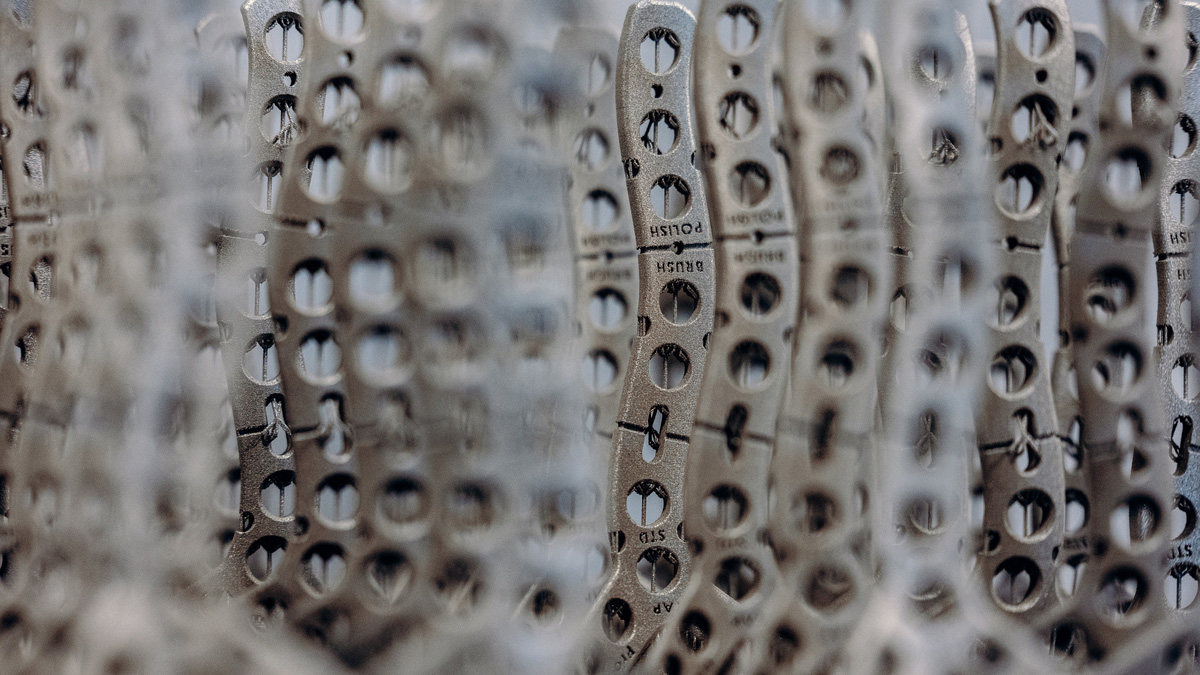
One of the main reasons to manufacture in smaller batches is flexibility. Rather than producing against a long-term demand forecast, quantities can more closely reflect what is needed now, with additional production runs following as requirements become clearer. This also helps minimize overall production costs, as you only need warehousing for the parts you need.
Match Production to Demand
This approach can be particularly useful when launching a new product or managing demand that changes over time. It limits the need to commit to a large quantity upfront while providing a route to increase production when demand supports it.
Make Changes Between Production Runs
Smaller batches can also create natural opportunities to incorporate design changes between runs. Feedback from early production parts, customers, or testing can inform the next iteration without affecting a much larger quantity of already-manufactured components.
Custom Production Runs
Sometimes batches are used for replacement parts, product variants, customized parts, and components for specialized industrial equipment. In these cases, small batch production can remain the production model rather than representing a step toward mass production.
Choosing a Manufacturing Process for Small Batch Production
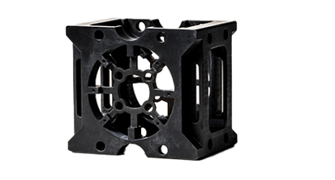
Small batch production can use the same manufacturing processes as prototyping and higher-volume production. CNC machining and 3D printing require little or no dedicated tooling, making them well suited to smaller quantities and designs that may still change. Injection molding requires more upfront investment in tooling, but can provide a practical route to repeat production of plastic parts when the expected volume justifies it.
| Process | Recommended For | Considerations |
|---|---|---|
| CNC machining | Precision metal and plastic parts | No dedicated tooling, broad material selection, and a straightforward route to repeat batches |
| 3D printing | Complex geometries, part variants, and lower quantities | No tooling required, making it easier to change designs or produce different geometries |
| Injection molding | Repeat production of plastic parts | Requires tooling upfront, but can provide repeatability and production-grade materials across multiple batches |
CNC Machining
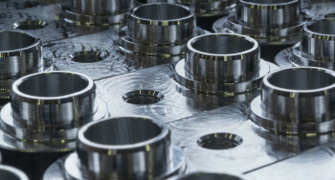
CNC machining can move from a prototype into small batch production without investing in a mold or other dedicated production tooling. Parts can also be manufactured from a broad range of production-grade metals and plastics, making CNC useful for precision components that need to maintain material and dimensional requirements across repeat orders.
3D Printing
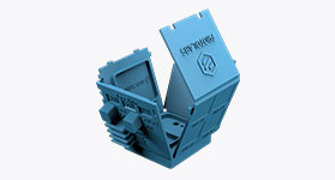
Within 3D printing, technologies such as MJF, SLS, and DMLS are particularly useful for testing parts for end-use production. They work well with complex geometries, and batches where quantities may change from one run to the next.
Injection Molding
For parts that need the properties and repeatability of a molded component, aluminum tooling can make molding practical at lower volumes. The upfront tooling cost means expected quantities and future demand play a bigger role in determining whether molding is the preferred option.
Where Small Batch Production Fits in the Product Life Cycle
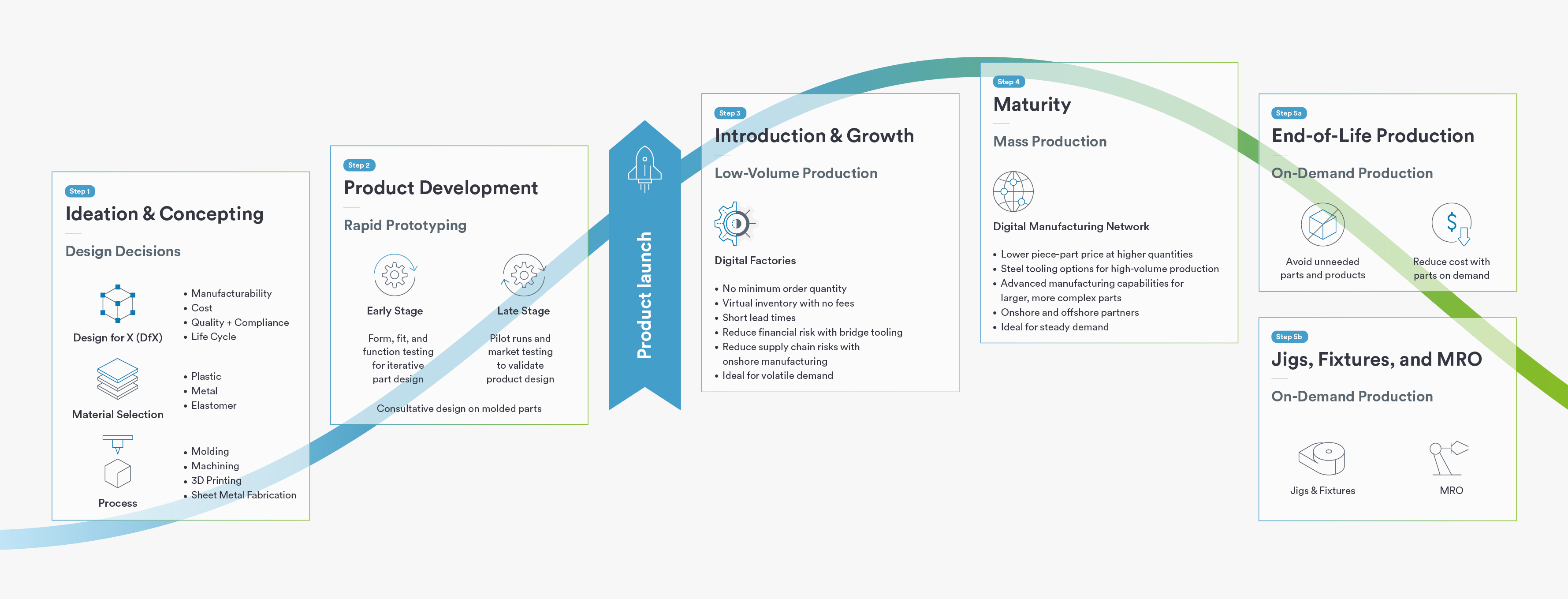
Small batch production can play different roles throughout the product life cycle. It is helpful for producing the first run of end-use parts after prototyping, supporting larger volumes as demand grows, and for products that simply don't require mass production.
During product development, small batches can provide production-grade parts for pilot runs, market testing, and final validation. From there, low-volume production can support a product launch without immediately committing to much larger quantities.
Small batches can also provide a bridge while higher-volume manufacturing is being established. Bridge production can keep parts available while production tooling or processes are being prepared, or provide additional supply when demand changes unexpectedly.
Later in the product life cycle, smaller runs can support replacement parts, maintenance requirements, and products approaching end of life, when producing and holding large quantities of inventory may no longer make sense.
Scaling up from Small Batch Production
As volumes grow, the manufacturing approach that worked for an initial batch may not remain the most practical or cost-effective option. Tooling investment can become easier to justify, while another process may offer better unit economics at higher quantities. This is where production planning becomes part of the wider supply chain strategy. Expected demand, how often parts are needed, and the cost of holding inventory can all influence whether to increase batch sizes or change manufacturing processes.
At Protolabs, our production experts can help evaluate those trade-offs based on your part and production requirements. With the combination of in-house digital manufacturing and a global manufacturing network, we can recommend an approach that fits the requirements of your project, with personalized advice on how to adapt as you scale.
FAQ
Is small batch production more expensive than mass production?
expand_less expand_moreSmall batches often cost more per part because setup and tooling costs are spread across fewer parts. However, they can require less investment upfront and reduce the risk of producing more parts than you need. The overall cost depends on the manufacturing process, part design, and how many parts you expect to produce.
When should you move from small batch to higher-volume production?
expand_less expand_moreThere is no universal quantity. Usually, product development ramps up when companies have stable demand, repeat orders, and are ready to invest in tooling suited to higher-volume production.
Is injection molding suitable for batch production?
expand_less expand_moreYes, depending on the economics and requirements of the part. The type of tooling, material, part geometry, and expected lifetime volume affect help inform the decision of whether injection molding is a stronger choice than CNC machining or additive manufacturing.
|


