
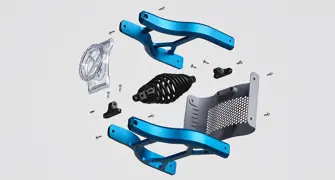

Designing for 3D printing often requires a careful balance between mechanical performance and visual quality. Understanding these trade-offs early can reduce redesigns, improve part performance, and accelerate time to production. As projects move beyond prototyping into end-use applications, this balance becomes even more important. Parts often need to meet mechanical requirements while also delivering consistent surface quality, especially for customer-facing or assembled components.
Why Strength and Aesthetics Are Often in Tension
In additive manufacturing, the features that improve strength do not always align with those that improve appearance. For example:
- Thicker walls increase stiffness and durability but can introduce sink marks or visible layering
- Reinforcement features such as ribs or gussets improve load-bearing performance but may impact surface uniformity
- Layer-based processes like FDM can create anisotropic strength, meaning parts are weaker along certain orientations
At the same time, surface finish requirements often push designs in the opposite direction:
- Smooth surfaces may require thinner layers or post-processing
- Cosmetic features may reduce structural efficiency
- Fine details can compromise durability if not properly supported
Understanding how to balance these competing priorities is key to successful part design.

Designing for Mechanical Performance
When a part needs to perform under load, geometry and material selection take priority. Consistent wall thickness helps reduce internal stresses and improves print reliability. Fillets and radii distribute forces more evenly, which lowers the risk of cracking or failure over time. Aligning key features with expected load paths improves structural efficiency and can reduce unnecessary material use. Find out more about additive manufacturing design considerations.
Material choice has a direct impact on performance. ABS-M30 provides improved strength and durability compared to standard ABS, making it a reliable option for functional prototypes and tooling. Nylon-based materials offer excellent toughness and fatigue resistance, which makes them well suited for parts exposed to repeated stress. Carbon-filled nylons increase stiffness and dimensional stability, though they tend to be less impact resistant than unfilled materials. Refer to our 3D printing materials guide for a full overview.
Choosing the Right Process
Each additive manufacturing process offers a different balance between strength and surface finish, the latter being a defining requirement for enclosures, housings, and other visible components. Selecting the right process depends on how the part will be used, the required tolerances, and the desired appearance.
FDM provides durable parts with good mechanical properties, particularly for indoor applications. While highly versatile and cost-effective, typically shows visible layer lines. This can be addressed through design choices such as orienting critical surfaces or by applying post-processing methods.
SLA produces smooth, high-detail surfaces that are well suited for cosmetic prototypes and fine features, though its material properties are typically better suited to prototypes or lower-load applications. SLS offers durable components with a more granular surface, while MJF often provides one of the most balanced outcomes. It produces strong, isotropic parts with reliable mechanical performance and a uniform finish that requires minimal post-processing.
Explore process options in more detail on the 3D printing service overview.
Material and Process Pairings That Work
Certain combinations of materials and processes naturally balance performance and appearance:
- MJF with PA12: Strong, consistent parts with good surface quality for production
- SLA with engineering resins: Smooth finish with moderate strength for functional prototypes
- FDM with ABS-M30: Durable parts with cost-effective performance for indoor applications
Choosing the right pairing can reduce the need for extensive post-processing while meeting both functional and visual requirements.

Post-Processing for Strong and Cosmetic Parts
Protolabs offers a range of post-processing options for 3D printing that improve surface quality and visual consistency without compromising the mechanical integrity of the part. Vapor smoothing, for example, reduces surface roughness on nylon components while maintaining their strength and durability, making it well suited for functional, end-use parts. Dyeing and painting add uniform color and a more refined, production-ready appearance, which is often required for customer-facing applications. By combining the right material and process with targeted finishing, it is possible to achieve both the structural performance needed for real-world use and the high-quality finish expected from production parts, effectively closing the gap between additive manufacturing and injection-molded aesthetics.
Post-processing should be considered as part of the overall design strategy rather than a last step. Designing with finishing methods in mind can reduce the amount of work required after printing and improve repeatability across production runs.
Scaling to Production
As designs transition from prototyping to production, consistency becomes a primary focus. Material behaviour, process stability, and repeatability all influence whether a part can be reliably manufactured at scale.
Technologies such as MJF are well suited for production environments, offering consistent mechanical properties and surface quality across batches. These processes support tighter tolerances and reduce variability, which is critical for end-use parts and assemblies.
Designs that account for both performance and appearance from the outset are easier to scale. They require fewer adjustments during validation and are more likely to meet production requirements without significant redesign.
|


