
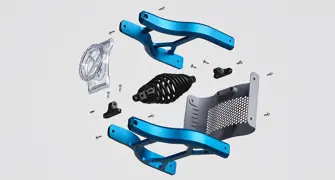
Using 3D Printing for Complex Jigs, Fixtures, and Other Tooling
Additive manufacturing is an excellent complement or alternative to machining when irregular, intricate, or smaller jigs and fixtures are needed
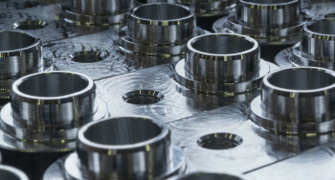
Manufacturers rely on jigs and fixtures to improve part accuracy, repeatability, and consistency. While these tools have traditionally been CNC machined, industrial 3D printing has become a practical alternative for certain applications.
As a general rule, if a fixture can be efficiently produced using 3-axis CNC machining, machining is often the preferred choice due to its material options, surface finish, and accuracy. For low-volume tooling, cost and lead time are frequently comparable between machining and additive manufacturing.
Why Use 3D Printing for Jigs and Fixtures?
3D printing is particularly effective for:
- Irregular or complex shapes
- Small tooling applications
- Designs that would be difficult to machine
- Production multiple fixtures cost-effectively
Recommended 3D Printing Technologies for Jigs and Fixtures
SLA: Best for Small, Detailed Tooling
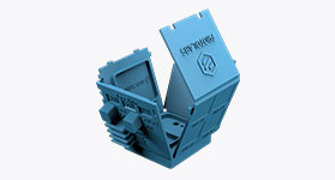
Stereolithography (SLA) is well suited for smaller jigs and fixtures that require excellent surface finish and fine detail resolution. While SLA materials offer limited durability compared to some alternatives, metal plating can improve wear resistance when needed.
SLS: Best for Larger Fixtures
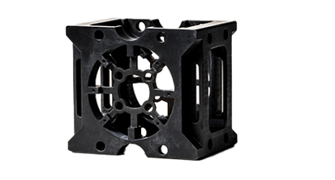
Selective Laser Sintering (SLS) is commonly used for larger jigs and fixtures. It produces durable, accurate parts with greater strength than SLA and offers a larger build volume. Parts typically have a rougher surface finish but perform well in functional tooling applications.

MJF: Best Balance of Speed, Quality, and Production Capability
Multi Jet Fusion (MJF) continues to gain popularity for tooling applications due to its speed, surface quality, and mechanical consistency. MJF produces durable nylon parts with fine feature resolution and is often a strong choice for production-ready jigs and fixtures.
DMLS: Best for Metal Tooling
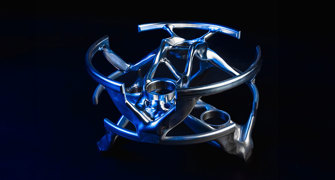
Direct Metal Laser Sintering (DMLS) produces near fully dense metal parts suitable for demanding tooling applications. It offers exceptional strength and durability, but it generally requires additional post-processing and longer lead times compared to polymer-based technologies.

Final Considerations
When designing jigs and fixtures for additive manufacturing, part orientation and load requirements should be considered, as printed components generally exhibit their greatest strength in the X-Y plane.
Ultimately, the best technology depends on the application. When CNC machining can efficiently meet the design requirements, it is often the preferred solution. When complexity, weight reduction, or manufacturability become challenges, additive manufacturing can provide significant advantages.


